

Zilbertsvayg, Zalmen
September 27, 1894-July 25, 1972
He was born in Ozorków, near Lodz, Poland, into a family that drew its pedigree back to the Malbim [Meyer Leybush ben Yekhiel Mikhl Wisser, 1809-1879]. He was the son of the Yiddish-Hebrew writer Tsvi-Hirsh Zilbertsvayg. At age three, he moved with his family to Lodz, studied there in a “cheder metukan” (improved religious elementary school), in the Lida Yeshiva of Rabbi Yitsḥak Yaakov Reines [1839-1915], and in a business course.
For a time he was employed in agricultural labor, later working as an employee in a commercial business. From his youth he was a lover of the Yiddish theater. In 1912 he managed amateur Hebrew and Yiddish theatrical troupes and founded Lida (Lodz Yiddish Dramatic Actors). In 1913 he was engaged as a translator of European theatrical repertoire at the Skala Theater in Lodz.
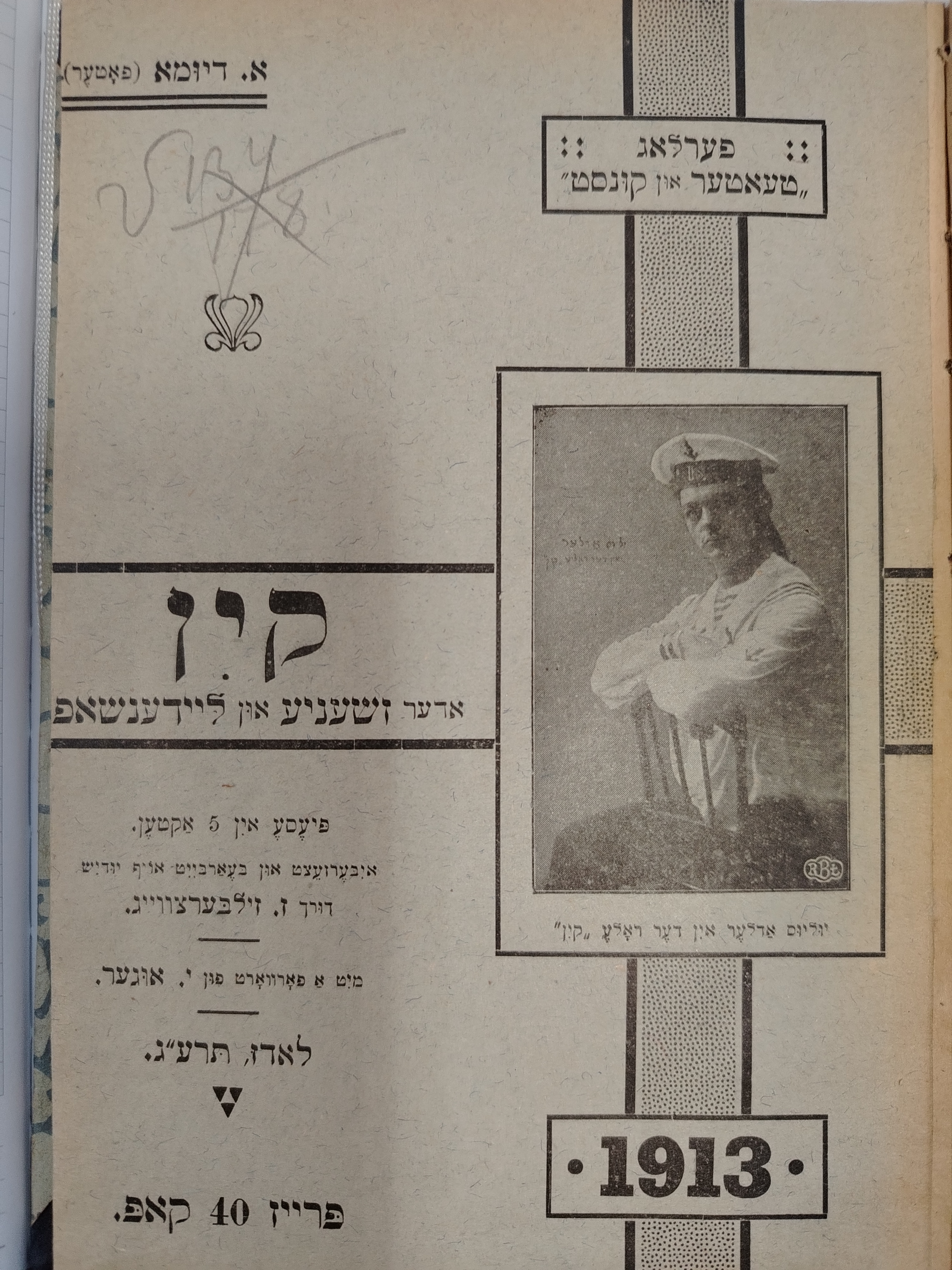
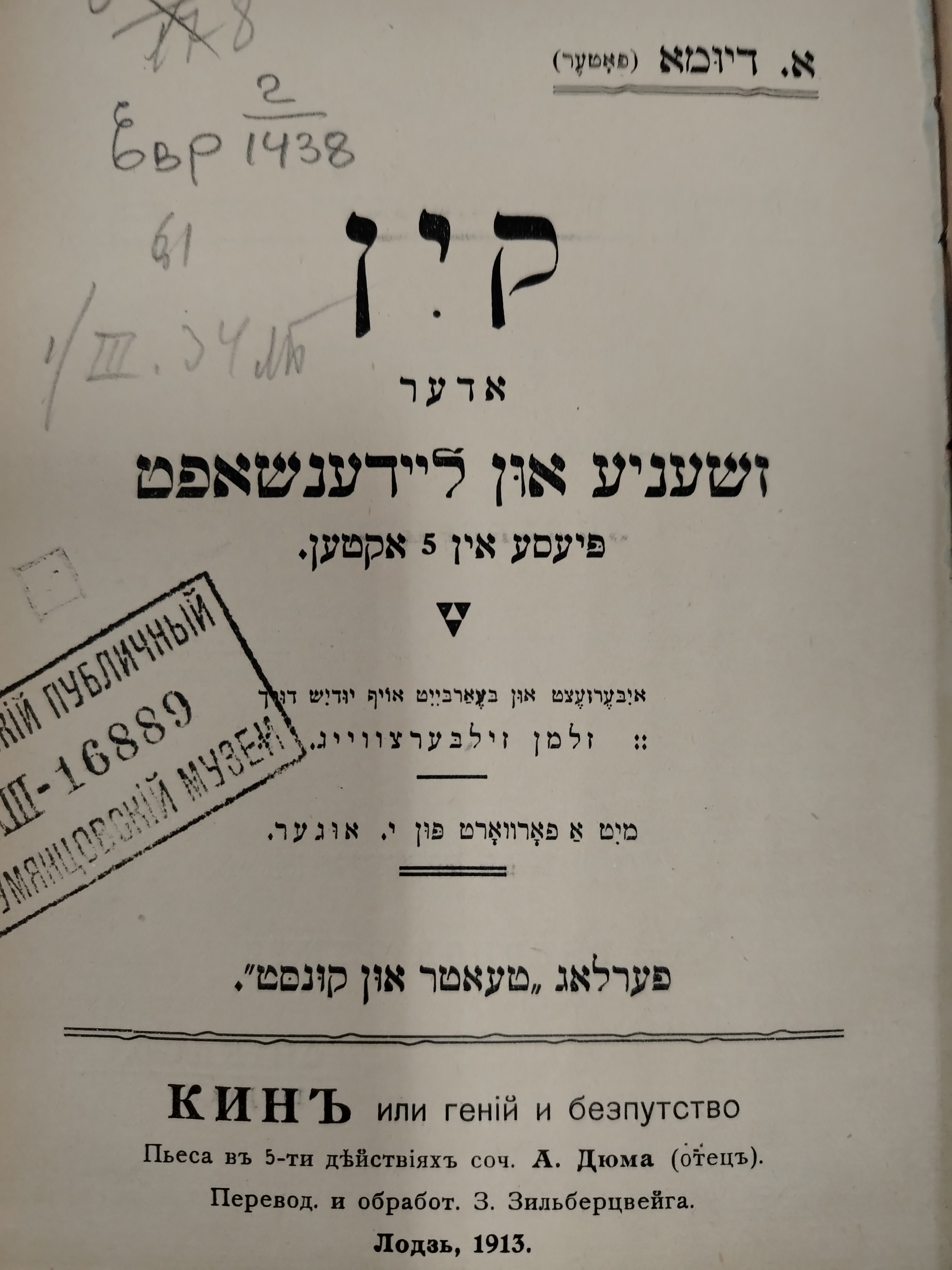
Zilbertsvayg translated and adapted for the Yiddish stage the play of Alexandre Dumas (father) Kin oder Zhenye un Laydenshaft : Pyese in 5 Akten (orig.: Kean, ou Desordre et Genie [Kean or Genius and the Libertine])/ A. Dyuma (foter) ; iberzetst un bearbayt oyf yudish durkh Zalmen Zilbertsvayg mit a forvort fun Y. Uger. (Lodz : Ferlag Teatr un Kunst, 1913), 100 pp., portr.
There are two portraits in the book: The portrait of the actor Julius Adler (1880-?) as Kean, dressed as a sailor is on the cover.
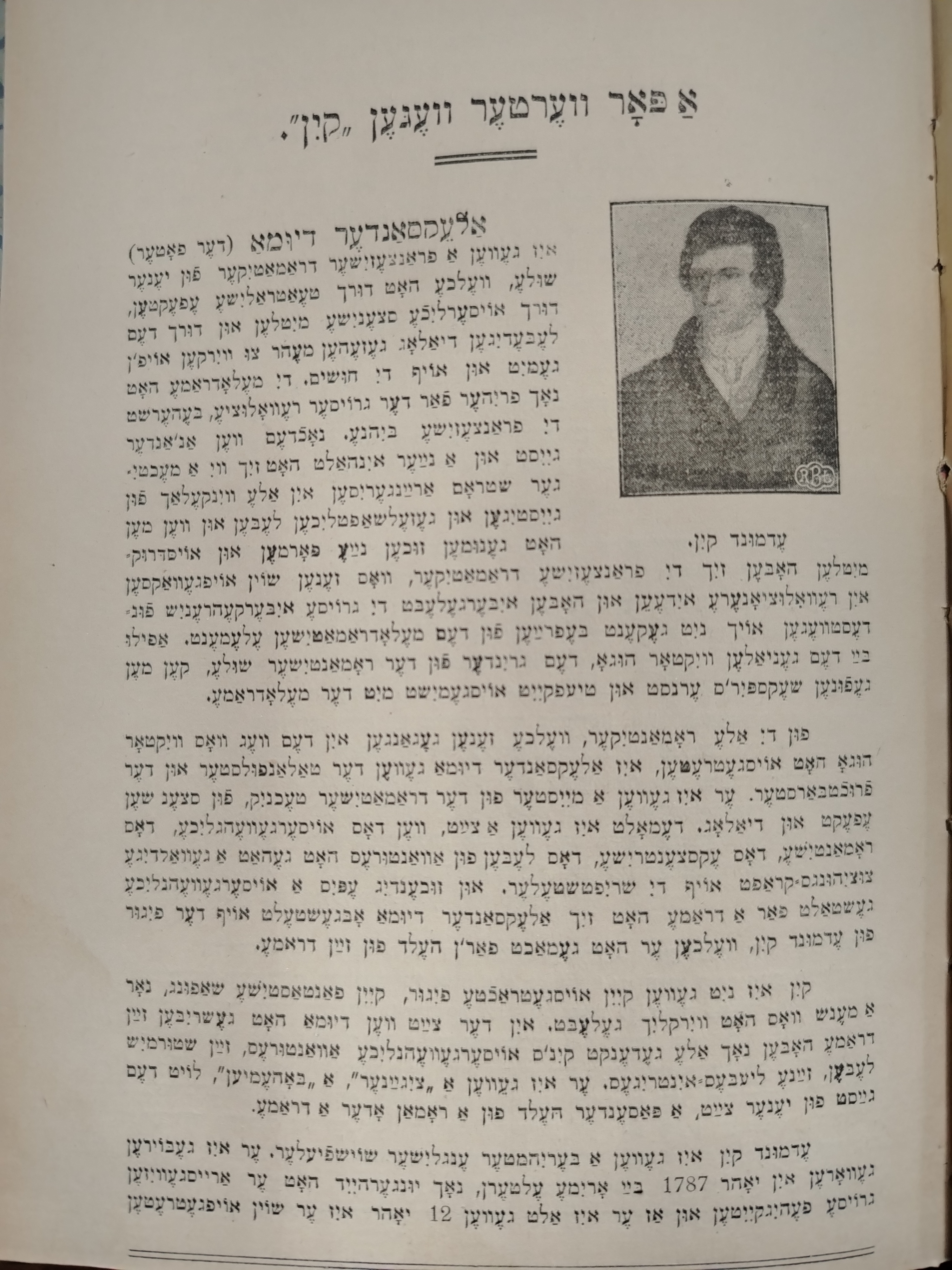
The portrait of Edmund Kean (1787-1833) the British stage actor, the prototype of the main character illustrates the preface by Yeshaye Uger.
During the German occupation, 1915-1918, he directed a wandering troupe through the Lodz hinterland and wrote for it sketches and one-act plays, and adapted pieces from European authors.
In 1922 he began collecting material for a book he planned on Yiddish actors and Yiddish theater, from which evolved into the bibliography for his Leksikon fun Yidishn Teater (Lexicon of the Yiddish Theater). He left Lodz in 1924 and settled in Israel and from there came to spend three months in the United States in 1926; he then returned to Israel, but in 1927 once again traveled to America. He went on to travel through the Jewish communities of the entire world, collecting materials for his Leksikon. He visited Argentina, Poland, France, England, and other countries in 1936. He returned to the United States in 1937, settling in New York, and was a contributor to the American division of YIVO, a member of the national executive of the Jewish National Labor Alliance, chairman of the United Lodz Relief, and other positions.
In 1948 he moved to Los Angeles, where from that point forward he ran (with his wife Celia) the Zilbertsvayg Yiddish Radio Hour, served as chairman and board member of the Committee for Jewish Education, chaired the local YIVO executive, and was active as well in other institutions.
He began writing humorous sketches in his youth, later publishing a translation from Polish of a sketch by Janusz Korczak in Lodzher Tageblat (Lodz Daily Newspaper) in 1910. He published, 1909-1910, in Avrom Reyzen’s Eyropeishe Literatur (European Literature) in Warsaw translated sketches and stories from European literature. In 1912 he became an internal contributor to Lodzher Tageblat (for a time, also co-editor), where over the years 1915-1924 he was one of its editors; and he published features, political articles, reportage pieces, humorous sketches, stories, adapted novels, and translations from European fiction, as well as critical essays about books, music, and Yiddish theater.
For many years he was the Lodz correspondent and contributor to Haynt (Today) in Warsaw, Forverts (Forward) in New York, and Idishe Tsaytung (Jewish Newspaper) in Buenos Aires, among others. He placed pieces also in: Fraye Erd (Free Land), Teater un Kunst (Theater and Art), Teater un Kino (Theater and Film), Heftn far Literatur (Notebooks on Literature), Der Idisher Zhurnalist (The Jewish Journalist)—and co-editor of the last four of these—Literatur (Literature), Yugend (Youth), Di Yetsige Tsayt (Contemporary Times), and other literary publications out of Lodz from 1912 on.
He also published in: Altnayland (Old-New Land) and Literarishe Bleter (Literary Newspaper) in Warsaw; Vilner Tog (Vilna Day) in Vilna; Dos Naye Lebn (The New Life) in Bialystok; Keneder Adler (Keneder Odler, Canadian Eagle) in Montreal; Morgn-Zhurnal (Morning Journal), Der Amerikaner (The American), Tsukunft (Future), Teater-Shtern (Theater Star), Pinkes fun Amopteyl (Records of the American Division of YIVO), and YIVO-Bleter (YIVO Monthly Bulletin) in New York; Parizer Haynt (Paris Today) and Unzer Vort (Our Word) in Paris; as well as for the Yiddish and Hebrew press in Israel.
He was editor of Der Amerikaner (New York, 1937-1948) and Lodzer Zikhroynes-Bukh (Volume of Lodz Memories) (New York, 1941), and co-editor of Elye Teneholts Yoyvl-Bukh (Elye Tenenholts Jubilee Volume) (New York, 1955).
Among his published books: Hintern Forhang (Behind the Curtain), articles and episodes from the Yiddish theater (Vilna, 1928), 207 pp.; Vos der Yidisher Aktyor Dertseylt, Kuryozn un Epizodn (What the Yiddish Actor Recounts, Curiosities and Episodes) (Vilna, 1928), 70 pp.; Teater-Zikhroynes (Memoirs of the Theater) (Vilna, 1928), 106 pp.; Avrom Goldfaden un Zigmunt Mogulesko (Avrom Goldfaden and Sigmund Mogulesko) (Buenos Aires, 1936), 186 pp.; Teater-Figurn (Theatrical Figures) (Buenos Aires, 1936), 159 pp.; Albom fun Yidishn Teater (Album of the Yiddish Theater) (New York, 1937), 116 pp.; Avrom Goldfaden, tsu zayn Hundertstn Geboyrn-Tog (Avrom Goldfaden, on his 100Th Birthday) (New York, 1940), 16 pp.; Teater-Mozaik (Theater Mosaic) (New York, 1941), 320 pp.; Akhad Hoom un zayn Batsiung tsu Yidish (Ahad ha-Am and his Connection to Yiddish) (Los Angeles, 1956), 140 pp.; Teater-Heftn, Far Byografyes un Lebns-Geshikhtes fun Yidishe Shoyshpiler, Rezshisorn, Dramaturgn (Theater Notebooks, Biographies and Life-Stories of Yiddish Actors, Directors, and Playwrights) (New York, 1943-1948), a portion of this material appears in the third volume of Leksikon fun Yidishn Teater.
His one-act plays include: Ir Shvester (Her Sister) (Warsaw, 1920), 32 pp.; Kharote (Regret), a children’s play with poetic text (Lodz, 1921), 32 pp.; Vide (Confession) and Der Medalyon (The Medallion) (Piotrików, 1920), 24 pp. He wrote the timely comedy, Poznanski un Kon (Poznanski and Kon), performed in Lodz in 1924, and the melodramas: Der Yidisher Revolutsyoner (The Jewish Revolutionary), Mit Farmakhte Oygn (With Eyes Shut), Man un Vayb (Man and Wife), Di Farbrekher (The Criminal), Di Shtoltse Froy (The Proud Woman), and others—performed in the Lodz hinterland during the years of WWI.
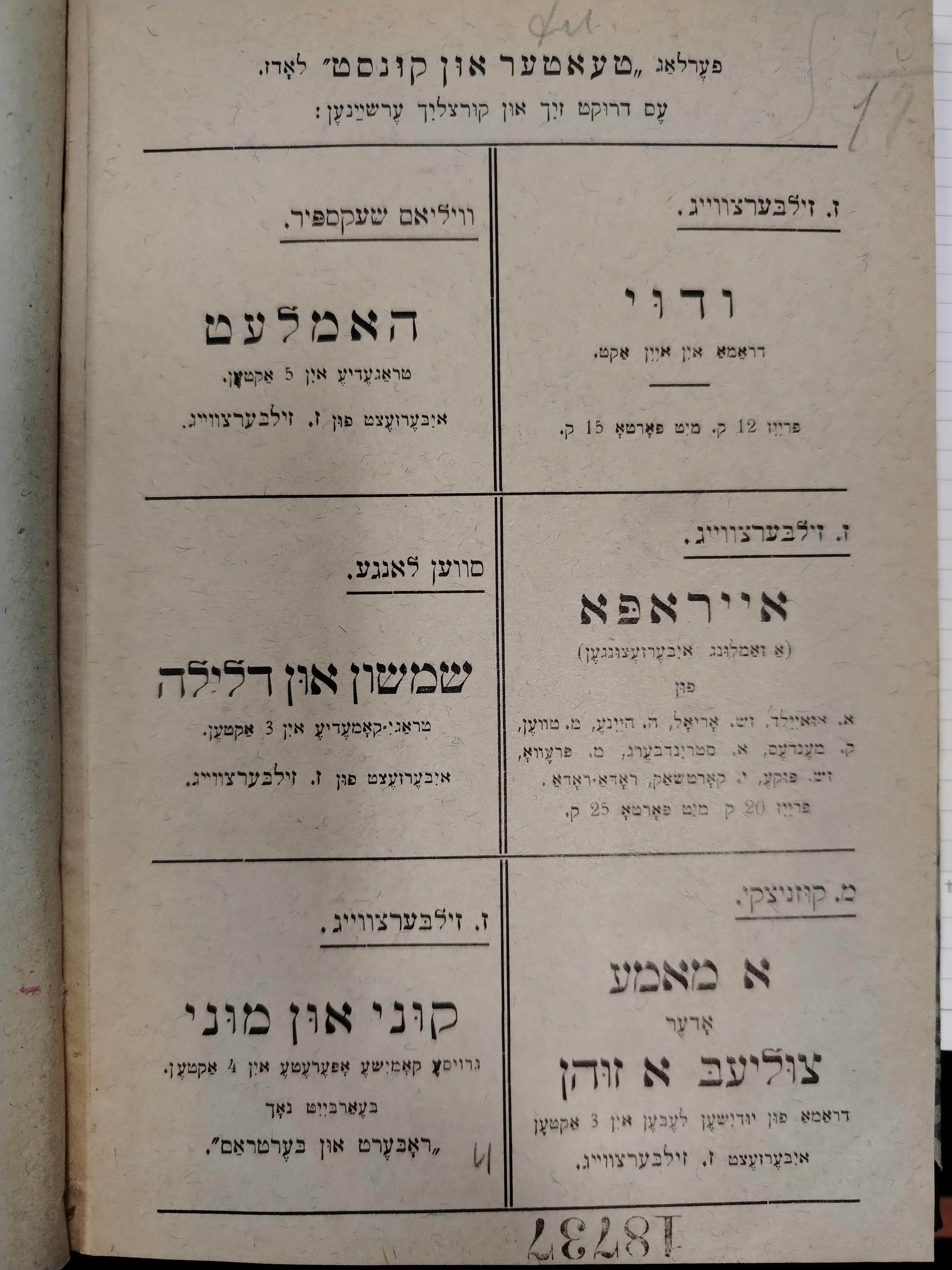
He translated and adapted for the Yiddish stage the plays of Alexandre Dumas, William Shakespeare, Hermann Sudermann, George Bernard Shaw, Henryk Ibsen, Herman Heijermans, Leonid Andreyev, Fyodor Dostoevsky, Arthur Schnitzler, Octave Mirbeau, and others as well. He also translated Jan Aleksander Fredro’s Doktor Rubinshteyn (Dr. Rubinstein) (Warsaw, 1920), 53 pp.
Zilbertsvayg’s most important accomplishment was his Leksikon fun Yidishn Teater (Lexicon of the Yiddish Theater) (New York: Elisheva, 1931-1969), six volumes, 3066 pp.; the first two volumes with Yankev Mestel. For this he compiled biographies of over 3000 Yiddish actors, playwrights, critics, directors, reviewers, and theatrical organizations which constituted the history of Yiddish theater for the previous 150 years. It also includes descriptions of Jewish wedding entertainers, actors in Purim plays, the Broder Singers, folksingers, as well as exhaustive monographs on Avrom Goldfaden, Yankev Gordin, Y. L. Perets, Dovid Pinski, Sholem-Aleykhem, Zalmen Reyzen, Perets Hirshbeyn, Sholem Asch, Mendele Moykher-Sforim, and others.
He also wrote later in life: Hantbukh fun Yidishn Teater (Lexicon of Yiddish Theater) (Mexico City, 1970), 195 pp. On the thirtieth anniversary of his literary work, there was published Zalmen Zilbertsvayg, Yoyvl Bukh (Jubilee Volume for Zalmen Zilbertsvayg) (New York, 1941), 123 pp.; and on the fiftieth birthday, Zalmen Zilbertsvayg (Zalmen Zilbertsvayg) (New York, 1945), 8 pp.
He died in Los Angeles.

Sources: Zalmen Reyzen, Leksikon, vol. 1; Z. Zilbertsvayg, Leksikon fun Yidishn Teater (Lexicon of the Yiddish Theater), vol. 1, pp. 784-786 (with a bibliography); H. Gudelman, in Teater-Shtern (New York) 6 (1926); H. Ehrenraykh, in Forverts (New York) (January 23, 1931; April 27, 1959); M. Osherovitsh, in Forverts (March 22, 1931; February 19, 1934; July 26, 1959); Dr. A. Mukdoni, in Morgn-Zhurnal (New York) (February 27, 1931; February 15, 1935); Mukdoni, in Kultur un Dertsiung (New York) (October 1956); Zalmen Reyzen, in YIVO-Bleter (New York) (Vilna) 2 (1931), pp. 251-66; V. Edlin, in Tog (New York) (January 15, 1932); N. B. Linder, in Tog (December 16, 1932); B. Ts. Goldberg, in Tog (December 27, 1932); Tsvien, in Forverts (February 9, 1935); Sh. Ernst, in Keneder Adler (Montreal) (October 15, 1940); Sh. Rozhanski, Dos Yidishe Gedrukte Vort in Argentine (The Published Yiddish Word in Argentina) (Buenos Aires, 1941), pp. 15, 188, 246; M. Ravitsh, Mayn Leksikon (My Lexicon), vol. 2 (Montreal, 1946); Dr. Y. Shatski, in YIVO-Bleter (New York) 28 (1946), pp. 185-87; Dr. N. Sverdlin, in Tog-Morgn-Zhurnal (New York) (June 24, 1954; September 3, 1959); Yankev Glatshteyn, in Idisher Kemfer (New York) (November 30, 1956); A. Leyeles, in Tog (December 8, 1956); Sh. Slutski, Avrom Reyzen Biblyografye (Avrom Reyzen’s Bibliography) (New York, 1956), no. 4755; A. Almi, in Fraye Arbeter-Shtime (New York) (January 11, 1957); Khayim Leyb Fuks, in Fun Noentn Over (New York) 3 (1957), pp. 199, 211, 212, 225, 258; Y. Shmulevitsh, in Forverts (June 14, 1959); M. Daytsh, in Heshbn (Los Angeles) (January 20, 1960).