
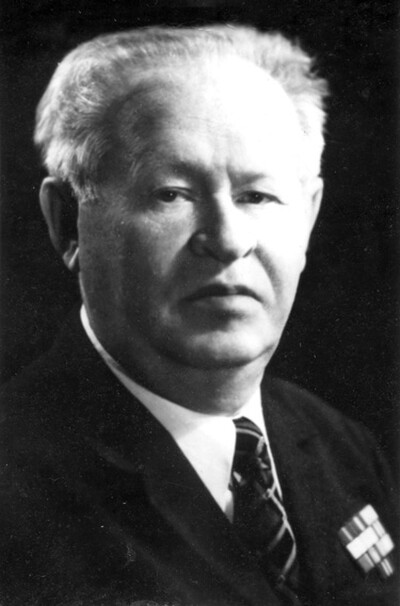
Talalayevski, Motl
1908–September 22, 1978
He was a poet, playwright, and prose author, born in the village of Mokhnachka, Ukraine. One can see from his first autobiographical poems that he came from an exceedingly poor home with numerous children: “Some had two, some four, and my mother eight—she had four by day and four by night.” All were boys and when WWII erupted, all went to the front to fight, among them Motl.
In 1919 the family moved to Kiev, and there at eleven years of age he earned his keep by selling cigarettes and nuts on the street corners. Five years later the future poet was working in a candy factory. Only later did he receive an education in a Soviet Jewish school. Over the years 1927-1929, he studied in Kiev initially at an “Arbfak” (Workers’ Faculty) and later at the Jewish Pedagogical Institute and the Yiddish division of the Literature Department of Kiev University, but he interrupted his education after the latter course of study.
In 1926 he debuted in print with a poem in the Moscow magazine Yungvald (Young Forest); one year later, his work appeared in a Kiev one-off publication in honor of the tenth anniversary of the October Revolution. His first poetry collection—Geslekh un Gasn, Lider 1926-1930 (Alleys and Streets, Poems, 1926-1930)—is lyrically tinged and naively sincere, mostly drawn from autobiographical episodes and feelings, but in subsequent collections he turned to conventional sloganeering poetry, a social requisite laid down by the Communist Party. Like the majority of young Soviet poets who came to literature at that time, his poems were full of enthusiasm and empty rhetoric:
The engines need resound, the walls tremble here—who’d bother, who’d interfere with this din and clamor?! No one would dare bar us, no one would fetter us, the din and clamor of the machines—this is our construction on the march!
So screams the poet in his “In Tsekh” (In the Shop), from the volume Komyugisher Farmest (Jewish Communist Youth Competition). He was a member of the Kiev group of young poets and prose writers, led by Dovid Hofshteyn, and from that point on he published his poetry in the daily newspaper Shtern (Star) in Kharkov and in the journals: Prolit (Proletarian Literature) in Kiev; Royte Velt (Red World) and Yunger Boy-Klang (Young Sounds of Construction) in Kharkov; Shtern in Minsk; in Kiev’s Literaturna Hazeta (Literary Gazette) in Ukrainian; and numerous other newspapers and magazines.
He wrote and published not only in Yiddish, but in Ukrainian and Russian as well. He sobered up from this false rhetoric only later, after the severe war years and especially after the pogrom in Yiddish culture in the late 1940s. On November 15, 1951, when he was on a creative assignment in the southern Ukrainian city of Nikolayev (Mykolayiv), during a meeting with readers to whom he was reading Ukrainian poems, he was arrested. He was banished for ten years to a camp with a severe regimen—the “reason” for such a harsh sentence: In his notebook there was discovered a poem entitled “Mayn Tsveyter Onheyb” (My Second Beginning):
I have forgotten that I am a Jew,
Though not once in this life has it been mentioned to me,
Then a new poem came to me
And I swore never to forget
And released from this distinct sin, neither who, what, or where I am….
This poetic oath remains deep in my heart,
But who can say if I’ll survive the war….
And so I write down this poem in my notebook,
Confusing the color with my own blood,
Written so thickly.
He was “rehabilitated” (i.e., exonerated) three years later, following the death of Stalin, for whom the poet sang paeans in the 1930s. Only many years later, however, did the opportunity return for him once again to publish in his mother tongue. Characteristic of this era was his poem “Far Vemen Shrayb Ikh” (For Whom Do I Write) which might generally be considered a justification for all Soviet Yiddish writers in those bitter years:
For whom do you write?—I was asked by a neighbor,
Who had forgotten his mother tongue….
A faint light which once burned,
Had for so long been extinguished,
As one puts out a light together with shadows on the walls….
For whom do you write? Wretched, depraved
Is your word now, what good is it for you to kindle it?
It’s like Latin—it was, no more, dead,
Your children won’t begin to understand your writing….
For whom do I write? My conscience offers up an answer for you.
Does one asks a tree for whom it is green,
Or the sun how it weaves so neatly with gold
The very least corners of our mother earth?
I write for those with whom it’s destined to speak my language,
It’s unimportant—whether their number is large or small—
In the great choir of mankind, it rings in my voice!
He wrote not only poetry but also prose. He published several novels in Sovetish Heymland (Soviet Homeland): Heyse Hertser (Warm Hearts) 11-12 (1970); Geknipt un Gebundn (Closely Linked) 11-12 (1974); and Yorshim (Heirs) 8-10 (1979); and a long story, Der Mames Bukh (Mother’s Book) 3-5 (1977). When little time remained for him, he brought out his last poetry collection, In Lebn Farlibt (In Love with Life).
During WWII, he was a major in the Red Army, and he survived the road from Stalingrad to Poland, working on the editorial boards of front newspapers. He also took part in battles against the Germans and in 1945 was decorated with the “Order of the Patriotic War” and other distinctions.
Soon after WWII, at a Sholem-Aleykhem celebration in Czernowitz, he chastised Russian and other Jews among the Holocaust survivors for escaping from the Soviet Union. Together with the Kharkov poet Z. Kats, he wrote two volumes of poetry in Russian, entitled [in English translation]: The Soldier and the Banner and Legend (published by the association of Soviet writers in Ukraine, “Radianski Pismenik”).
Together with Hershl Polyanker and Yekhiel Falikman, he was (in 1947) a member of the organizing bureau of the revived section of Yiddish writers in the association of Soviet writers in Ukraine. In 1948 he published poems in Eynikeyt (Unity) in Moscow.
He also translated from Ukrainian literature into Yiddish, and his plays were staged in the Ukrainian theater. Among his dramas in Ukrainian, there is one about Johannes Gutenberg, the inventor of printing, translated by the Soviet Jewish writer M. Danyel (Daniel Meierovich).[1]
He died in Kiev.
His published books include: Geslekh un Gasn, Lider 1926-1930 (Kharkov: Central Publ., 1930), 188 pp.; Oyfshteyg (Ascent) (Kharkov, 1932), 55 pp.; Komyugisher Farmest (Kiev: Literatur un Kunst, 1932), 157 pp.; Erdn Kolvirtishe (Earthen Collective Farm) (Minsk: Byelorussian State Publishers, 1934), 94 pp.; Af Der Vakh (On Guard), poetry (Kiev-Kharkov: Ukrainian State Publishers for National Minorities, 1934), 137 pp.; Fun Fuln Hartsn, Lider (With a Full Heart, Poems) (Kiev-Kharkov: State Literary Publishers, 1935), 165 pp.; In Mayn Ukraine (In My Ukraine) (Kiev, 1937); Heymland, Lider (Homeland, Poetry) (Kiev: Ukrainian State Publishers for National Minorities, 1939), 204 pp., with drawings by A. Fayershtuk; Libe (Love), poetry (Kiev: Ukrainian State Publishers for National Minorities, 1940), 104 pp., with a picture of the author; Vi a Soldat, Lider 1941-1945 (As a Soldier, Poems 1941-1945) (Moscow: Emes, 1946), 125 pp.; a poetry cycle in Horizontn (Horizons) (Moscow: Sovetski Pisatel, 1965); In Lebn Farlibt, Lirishe Lider (In Love with Life, Lyrical Poems) (Moscow: Sovetski Pisatel, 1978), 133 pp.
His work also appeared in: Shlakhtn (Battles) (Kharkov-Kiev: Ukrainian State Publishers for National Minorities, 1932); Komsomolye (Communist Youth) (Kiev: Ukrainian State Publishers for National Minorities, 1938); Heymland (Homeland) (Moscow: Emes, 1943); and Tsum Zig (To Victory) (Moscow: Emes, 1944).
The Sholem-Aleykhem state theater in Kiev in 1947 staged his play Afn Gantsn Lebn (For a Whole Life). He also wrote a second play in 1947 entitled An Ort Unter der Zun (A Place Beneath the Sun), which was neither published nor produced, as well as a new book of poems entitled Lekhayim (To life).
[1] Translator’s note. A common error: Gutenberg was the inventor of printing in the West, as East Asians had printing many centuries before Gutenberg was born. (JAF)
Sources: A. Holdes, in Farmest (Kharkov) (May-June 1934); I. Druker, in Farmest (February 1936); Druker, in Sovetishe Literatur (Kiev) (February 1938); N. Y. Gotlib, in Keneder Adler (Montreal) (October 3, 1941); Gotlib, Sovetishe Shrayber (Soviet Writers) (Montreal, 1945), pp. 51-52; A. Kushnirov, in Naye Prese (Paris) (July 27, 1945); Kushnirov, in Eynikeyt (Moscow) (February 4, 1947); Kushnirov, in Yidishe Kultur (New York) (April 1947); Y. Dobrushin, in Eynikeyt (August 9, 1945); A. Kipnis, in Eynikeyt (September 25, 1945); H. Vaynraykh, Blut af der Zun (Blood on the Sun) (New York, 1950), p. 21; Y. Katsenelson, in Morgn-Frayhayt (New York) (March 11, 1956); N. Mayzil, in Dos Yidishe Shafn un der Yidisher Arbeter in Sovetn-Farband (Jewish Creation and the Jewish Worker in the Soviet Union) (New York, 1959), see index; oral information from Y. Birnboym in New York; E. I. Simons, Through the Glass of Soviet Literature (New York, 1953), pp. 146, 148, 150.