
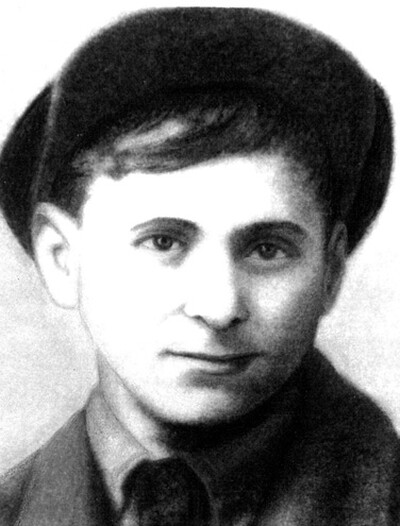
Yankelevitsh, Yankl
1904–1938
He was a poet and prose author, born in the Bessarabian town of Goneshti, and later his family moved to Dubasari. His father, Arn Yankelevitsh, ran a shop selling paper and writing implements; he died when Yankl, the youngest in the family, was fourteen, and Yankl thus had to go to work. He studied in religious primary school and public school, before becoming a laborer painting signs for urban shops and other institutions. After the Bolshevik Revolution, he continued his education. Over the years 1925-1933, he lived in Odessa, studied in the Yiddish division of the local pedagogical institute (graduating in 1932).
He was writing poetry from his childhood and began publishing them in 1928 in Odessa in Odeser Arbeter (Odessa Worker). After graduation, the authorities sent him to the then capital of Soviet Moldavia in Tiraspol to teach. He taught Yiddish language and literature there until 1938 in the Tiraspol Jewish middle school. At the same time, he published poems, stories, articles, children’s tales, and translations in such Yiddish publications as: Yungvald (Young Forest), Der Pyoner (The Pioneer), and Der Emes (The Truth)—in Moscow; Yunger Boy-Klang (Young Sound of Construction), Yunge Gvardye (Young Guard), Di Royte Velt (The Red World), and Prolit (Proletarian Literature)—in Kharkov; Der Shtern (The Star), Zay Greyt (Get Ready), Proletarishe Fon (Proletarian Banner), Sovetishe Literatur (Soviet Literature), and Vos geven un Vos Gevorn (What Was and What Will Be), an anthology—in Kiev; and Oktyabr (October) in Minsk; among others.
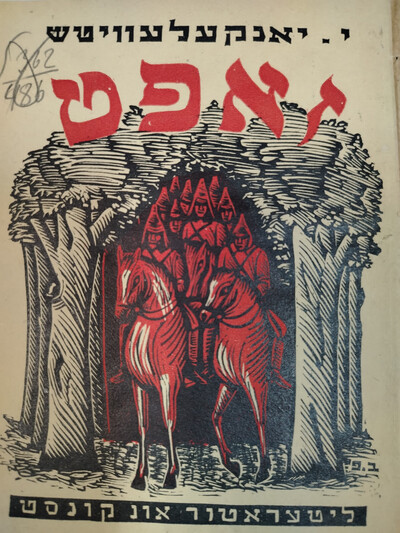
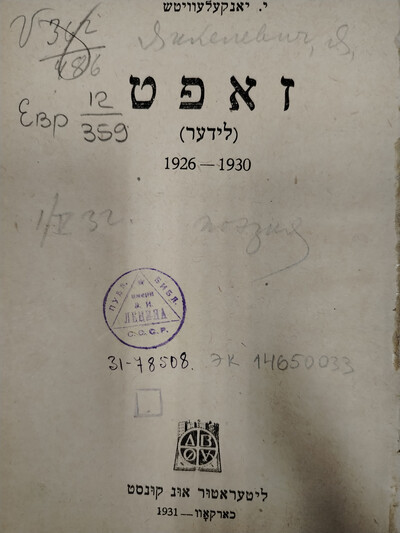
His first poetry collection, Zaft (Juice) appeared in print and was warmly received by both readers and literary critics.
Tiraspol was very close to Odessa, and he frequently traveled to the latter city, where the local Yiddish writers held him in high repute and gladly welcomed him into their literary family. In 1937, the year before his tragic death, he published a collections of stories for children: Khaveyrim (Comrades).
On March 31, 1938 he was arrested in Tiraspol. The principal charge against him was that he had protested against the local Party and state organs which had carried out the closing of local Jewish schools. He was sentenced to ten years of forced labor without rights. This was, of course, nothing short of a cover for a death sentence. In 1956 his family received an official notice of his rehabilitation (exoneration), “because the procurator found no evidence in his case of criminal guilt.” According to Hershl Vaynraykh, he was murdered by the NKVD.
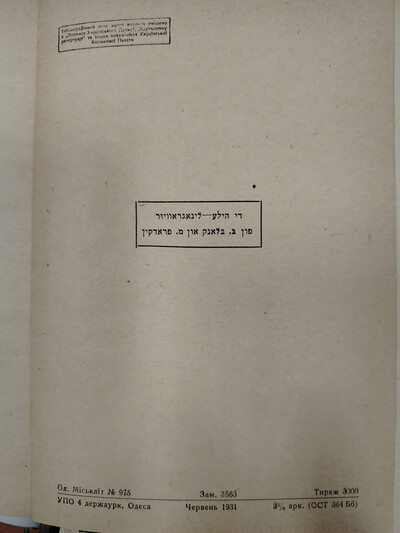
He authored the collection Zaft, Lider, 1926-1930 (Juice, Poetry, 1926-1930) (Kharkov: Literatur un Kunst, 1931), 107 pp.; these poems were sharply criticized by the Communist critic Hersh Remenik (in Prolit) because they “lacked motifs which should have celebrated the Bolshevik Revolution in the building of socialism.” He was also the author of Lagern (Camps), poems about the Red Army, the Moldavian steppes, and the like (Kharkov-Kiev: Ukrainian State Publishers for National Minorities, 1934), 74 pp.; Khaveyrim, Detseylungen far Kinder (Comrades, Stories for Children) (Kiev: Ukrainian State Publishers for National Minorities, 1937), 48 pp.; Fraynt (Friend), nature motifs, poems of youth and love, and Moldavian ballads (Kiev: Ukrainian State Publishers for National Minorities, 1938), 89 pp.
His work was represented in: Shlakhtn, Fuftsn Yor Oktyaber in der Kinstlerisher Literatur (Battles, Fifteen Years in Artistic Literature), compiled together with Hershl Orland and Boris Kahan (Kharkov-Kiev: Ukrainian State Publishers for National Minorities, 1932); Deklamater fun der Sovetisher Yidisher Literatur (Reciter of Soviet Yiddish Literature) (Moscow: Emes, 1934); Komyug, Literarish-Kinstlerisher Zamlbukh ([Jewish] Communist Youth, Literary-Artistic Anthology) (Moscow: Emes, 1938).
Sources: M. Kashtshevatski, in Prolit (Kharkov) (March-April 1930); H. R. (Remenik), in Prolit (September-October 1931); A. Abtshuk, Etyudn un Materialn tsu der Geshikhte fun der Yidisher Literatur Bavegung in FSRR (Studies and Material for the History of the Yiddish Literature Movement in the Soviet Union) (Kharkov, 1934), p. 336; Y. Bronshteyn, Sheferishe Problemen fun der Yidisher Sovetisher Poezye (Creative Problems in Soviet Yiddish Poetry) (Minsk, 1936), p. 59; A. Druker, in Yunge Gvardye (Kharkov) 25 (1935); H. G. in Proletarishe Pen (Kiev) 46 (1935); H. Vaynraykh, Blut af der Zun (Blood on the Sun) (New York, 1950), pp. 51, 194-95.
Y. Yankelevitsh contributed his works to Yunger arbeter: literarish-gezelshaftlekhe khrestomatye far der 2 un 3 grupn fun ovntshuln far arbeter-yugnt (Young worker: reader for evening schools for working youth) / tsunoyfgeshtelt L. Tsart, L. Taker un N. Raginski; unter der redaktsye fun D. Mats.- Minsk: Melukhe-farlag fun Vaysrusland, 1927.- 180 pp.
יונגער ארבעטער: ליטעראריש-געזעלשאפטלעכע כרעסטאמאטיע פאר דער 2 און 3 גרופן פון אװנטשולן פאר ארבעטער-יוגנט
צונױפגעשטעלט ל. צארט, ל. טאקער, נ. ראגינסקי אונטער דער רעדאקציע פון ד. מאץ
Y. Yankelevitsh contributed his poems to Almanakh VUSPP (Alukrainishe asotsyatsye fun proletarishe shrayber: yidishe sektsye (Almanac of Yiddish proletarian writers of Ukrain)/ kinstlerishe formirung - kinstler B. Blank un M. Fradkin.- Kharkov: Tsentrfarlag, 1929.- 363, [4] pp., ill., initials.
אלמאנאך װוספפ (אלאוקראינישע אסאציאציע פון פראלעטארישע שרײבער) : אידישע סעקציע
קינסטלערישע פארמירונג - קינסטלער ב. בלאנק און מ. פראדקין
Artists: Бланк, Бер Пинхусович = Бланк, Борис Павлович (1897-1957) and Фрадкин, Моисей Залманович = Фрадкин, Михаил Зиновьевич (1904-1974).