
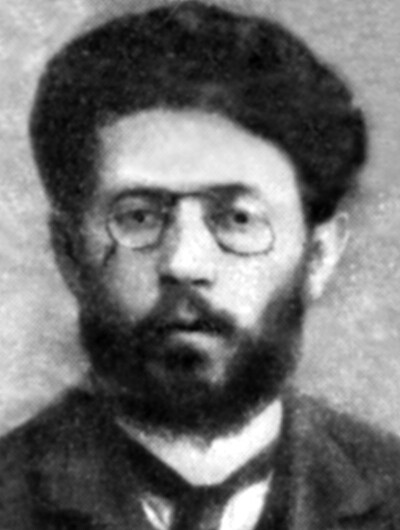
Yuditski, Avrom
ca. 1885-January 6, 1943
A literary scholar and historian, he was born in the town of Korsun', Ukraine. He received a traditional Jewish education in religious elementary school and yeshivas.
At the time of the first Russian Revolution (1905), he joined the Bund and was active in the Jewish labor movement in Ukraine and Byelorussia. In 1912 he was living in St. Petersburg, later until early 1916 in Vilna.
When the Germans during WWI approached the city, Yuditski moved into Russia and until 1917 lived in Irkutsk. After the February Revolution (1917), he returned to St. Petersburg, was active there in the Bund, and later (around June 1917) when the central committee of the Bund moved to Minsk, Byelorussia, he too made his way there and became a contributor to the editorial board of the Bundist central organ, Der Veker (The Awakener).
In late 1918 he traveled to Warsaw, and there he was interned in a prison camp in Chełm, from which he escaped to Kiev. When the Russian Bund split, he went over to the Communist Bundists, and from that point forward he was their leader in the realm of Yiddish culture and literature. Until the German assault on Russia (June 1941), he was a consultant on questions of history for the Moscow Yiddish State Theater.
He was evacuated in July 1941 to Inner Asia, for a time worked there on a collective farm, before making his way to Tashkent, living in great need. Broken physically and mentally, a forlorn and disappointed man, and moreover perennially suffering from hunger, he died in a hospital in Tashkent after a serious illness.
He began writing for the monthly journal Di Idishe Velt (The Jewish World), of which he was editorial secretary, in St. Petersburg in 1912, and later was a contributor to Hazman (The Times) in Vilna (1912)—as a Bundist he wrote solely in Hazman on literary and cultural topics—and near the beginning of WWI (ca. 1915) he was an internal contributor to the Vilna daily Der Fraynd (The Friend) which F. Margolin published.
After the 1917 Revolution, he wrote intensively for Di Arbayter-Shtime (The Voice of Labor) in Petrograd (1917) and Der Veker in Minsk (1917-1918). From 1919 he was a regular contributor to the Jewish Communist press in Russia. In the 1920s and 1930s, he worked with the Institute for Jewish Culture in the Ukrainian Academy of Sciences. He wrote a series of important works on the history of the Jewish labor movement. He was a serious researcher into Jewish cultural history and the Yiddish press in Russia, engaged as well in Yiddish bibliography.
Among other items, he published in: Der Apikoyres (The Heretic) in Moscow (1924-1925) a portion of his work on religion and “bourgeois Jewish historical philosophy”; “Vegn a proyekt fun a yidishn zhurnal in Rusland in di 50 yorn” (On a project for a Yiddish journal in Russia in the 1850s), in Logisher Zamlbukh (Logic Anthology) 1 (Moscow-Kharkov); “Vegn di politish-gezelshaftlekhe rikhtungen in Yude in di ershte yorn far un nokh unzer tsaytrekhenung” (On the political and social directions in Judea in the first years before and after [the beginning of] the Common Era), Sovetish (Soviet) in Moscow (1938); “Vegn inhaltn fun Volf Kamrashs pyese ‘Kohol in Shtetl’” (On the contents of Volf Kamrash’s play, “Kohol in Shtetl”), Shriftn (Writings) in Kiev (1928); “Yidishe Revolutsyonere Bavegung in 1905” (The Jewish Revolutionary Movement in 1905), Royte Velt (Red World) in Kharkov (1924-1935) and “Yidishe aRbeter-Bavegung af Ukraine” (The Jewish Labor Movement in Ukraine), Royte velt 1, 2, 3, 4 (1926); “Yidishe Burzhuazye un Yidisher Proletaryat In Ershter Helft 19 Y״h (The Jewish Bourgeoisie and the Jewish Proletariat in the First Half of the Nineteenth Century), Historisher Zamlbukh (Historical Anthology) in Kiev (1930), which appeared in book form (Kiev: Proletar, 1931), 120 pp., with a foreword by the author. The last work was the first part of his monograph on the economic history of Jews in Russia in the first half of the nineteenth century in a variety of fields involving the popular economy. He also contributed to: Emes (Truth) in Moscow; Der Shtern (The Star) in Kharkov-Kiev; Prolit (Proletarian Literature) in Kharkov; and Oktyabr (October) in Minsk; among other serials.
His published books include: Der Veg tsu Oktyabr, Revolutsyonere Bavegung in Rusland, 1895-1917 (The Road to October, the Revolutionary Movement in Russia, 1905-1917), edited by Kh. Mironer, with a foreword by M. Rabinovitsh (Kiev: Kultur-Lige, 1925), 372 pp.; Polit-Ivre (The Abcs of Politics) (Kiev: Kultur-Lige, 1926), 232 pp., with Leyb Mishkovski.
He compiled the collections: 1905, Zamlung (1905, Collection) (Kharkov: Ukrainian State Publishers, 1925), 120 pp.; Oktyabr-Zamlung (October Collection), with E. Finenberg (Kharkov: Ukrainian State Publishers, 1929), 73 pp.; Polit-Ivre far Polit-Shuln (The ABCs of Politics for Political Schools), part 1 (Moscow, 1926), 8 pp.; Oktyaber-Teg, Materyaln tsu der Geshikhte fun der Oktyaber-Revolutsye Tsum 10 Yorike Yubiley (October Days, Materials on the History of the October Revolution on its Tenth Anniversary), edited by Yoysef Liberberg (Kiev: Kultur-Lige, 1927), 432 pp.; Parizher Komune, Zamlung (The Paris Commune, Collection) (Kharkov: Kultur-Lige, 1931), 183 pp.; Narodovoltses, Materialn-Zamlung Tsum Fuftsik Yorikn Yubiley fun Narodnaya Volya (The Populists, Collection of Materials on the Fiftieth Anniversary of Narodnaya Volya [People’s Will]) (Moscow: USSR Central People’s Publishers, 1932), 243 pp.; Etyudn tsu der Alt-Yidisher Geshikhte, Loyt A. Ranovitshes Bukh, “Etyudn Iber der Geshikhte fun der Alt-Yidisher Religye” (Studies in Ancient Jewish History, According to A. Ranovich’s Book, Ocherk Istorii Drevneevreiskoi Religii [Studies in the History of Ancient Jewish Religion] (Moscow: Emes, 1940), 82 pp.; Yidishe Folkslider (Yiddish Folksongs), with Yekhezkl Dobrushin (Moscow: Emes, 1940), 486 pp., Russian edition (Evreiskie Narodnye Pesni) (Moscow, 1947), 279 pp.
He was co-editor, with Meyer Viner, of an edition of Yisroel Aksenfeld’s work and wrote an introduction there entitled “Der Oytser oder di Genarte Velt” (The Treasure or the Disappointed World), in Y. Aksenfelds Verk (Y. Aksenfeld’s Works) (Kharkov: Literatur un Kunst, 1931).
He translated into Yiddish Sergei Ingulov’s Politgramote (Fundamentals of Politics [original: Politgramota]), textbook for party candidate school (Moscow: Emes, 1935), 426 pp.; and M. A. Gremiatskii’s Funvanen Shtamt der Mentsh? (Where Does Man Come From? [original: Kak Proizoshel Chelovek]) (Kiev: Ukrainian State Publishers for National Minorities, 1940), 155 pp.
Sources: Zalmen Reyzen, Leksikon, vol. 1; Biblyografishe Yorbikher fun YIVO (Bibliographic Yearbooks from YIVO) (Warsaw, 1928), see index; Y. Shatski, in Teater-Arkhiv (YIVO, Vilna and New York) (1930), pp. 474-75; Shatski, in YIVO-Bleter (Vilna) 6.2 (1934), pp. 268-70; Kh. Verber, Afn Visnshaftlekhn Front (Minsk) 3-4 (1933); Sh. Khayes, Otsar beduye hashem (Thesaurus Pseudonymorum; Treasury of Pseudonyms) (Vienna: Glanz, 1933), p. 150; N. Rubinshteyn, Dos Yidishe Bukh in Sovetn-Farband in 1932, 1933, 1934 (The Yiddish Book in the Soviet Union in 1932, 1933, 1934) (Minsk, 1934), see index; Al. Pomerants, in Dovid Edelshtat Gedenk-Bukh (Dovid Edelshtot Memory Book) (New York, 1953); Y. Keytlman, in Forverts (New York) (May 10, 1953); N. Mayzil, Dos Yidishe Shafn un der Yidisher Arbeter in Sovetn-Farband (Jewish Creation and the Jewish Worker in the Soviet Union) (New York, 1959), pp. 35, 128.
Photos courtesy of the Russian State Library (Moscow), Oriental Centre.
These relate to the previous comment.
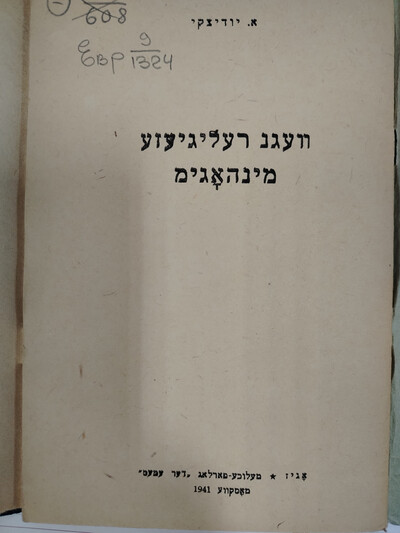
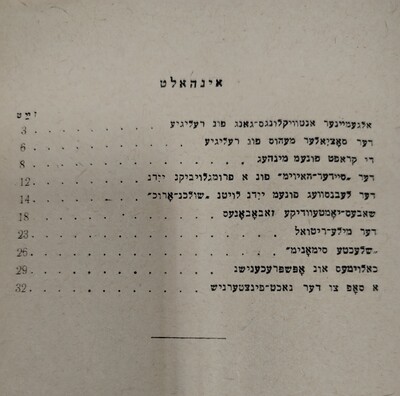
Yuditski, Avrom wrote Vegn religyeze minhogim (About religious ceremonies/rituals).-
Moskve: Melukhe farlag der Emes, 1941.- 33, [3] pp. Ed. Moyshe Altshuler.
װעגנ רעליגיעזע מינהאגים
א. יודיצקי