
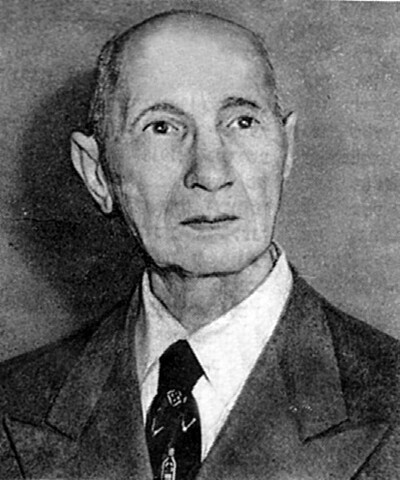
Lyubomirski, Shiye
June 16 1884-August 22, 1977
The brother of Khayim Lyubomirski (Hyman Lewbin), he was a theater historian and current events author, born in a village near the city of Brusilov (Brusyliv), Kiev district, Ukraine. He initially received a traditional Jewish education, studying until age thirteen in religious elementary schools, before moving to the city of Kiev where his father brought him. There, he passed the examinations for entrance into the eighth class in high school in 1907, and to support himself he began giving private lessons in Russian literature, Latin, mathematics, and history. He would later become a teacher in the town of Makarov (Makariv), Kiev district, where he directed and acted in local, secret literary-dramatic circles.
In 1911 he became a student in the economics and law department of the Kiev Commerce Institute and a teacher of Yiddish language and literature in the Demievko Jewish School. He graduated from the Institute in 1914 and became a teacher of literature in a school at which one prepared graduates for senior high school. He was again living and teaching in Makarov in 1917-1918, where he was the manager and teacher in the local Jewish elementary school. In 1918 he moved to Kiev and began working with the Yiddish theater there; when the Polish army occupied Ukraine, he joined the Red Army and worked as a teacher and director of amateur army theater troupes. Demobilized in 1921, he became an actor and director in the first Yiddish state theater. In 1922 he was a student in the theatrical studio associated with the Moscow Yiddish Chamber Theater.
In 1924 he began his work as a Moscow Yiddish theater critic. Over the course of more than a half century, he published some 400 articles and essays on theater and literature in both Yiddish and Russian newspapers, journals, almanacs, and anthologies, published several books on theater arts generally and Yiddish theater in particular. For his book, Der Revolutsyonerer Teater (The Revolutionary Theater), A. Granovski, the first artistic director of the Moscow Yiddish state theater composed a forward. Lyubomirski assembled a rich body of material on the history of fourteen Yiddish state theaters and numerous Yiddish drama circles, which existed in Soviet Russia on the eve of WWII, including those in Odessa, Kiev, Minsk, and Birobidzhan, and he frequently visited theatrical collectives to give lectures on the history of theater.
In 1941 he joined the Red Army as a regular soldier, and he participated in the defense of Moscow with the Red Army and was wounded in battle. He took part in a series of battles at the front and was active as a member of the historical commission of the Jewish Anti-Fascist Committee.
Over the course of the last decade and a half of his life and work, he published in Sovetish Heymland (Soviet Homeland) in Moscow a great number of articles and memoirs on issues of literature and theater. In his last book, Af di Lebnsvegn, Fartseykenungen (On the Paths of Life, Notes), he selected memoirs and essays about Yiddish writers and actors.
He died in Moscow.
He contributed articles and longer treatments to the anthologies of Sovetishe Literatur (Soviet Literature), as well as to Emes (Truth) and Eynikeyt (Unity)—all in Moscow; Teater-Bukh, Zamlung Tsum Fuftsikyorikn Yubiley Funem Idishn Ṭeater (1876-1926) (Theater Book, a Collection on the Fiftieth Anniversary of the Yiddish Theater, 1876-1926) (Kiev: Kultur-Lige, 1927); Yidishe Shriftn (Yiddish Writings) and Folks-Shtime (People’s Voice) in Warsaw; Parizer Tsaytung (Parisian Newspaper) in Paris; Yidishe Kultur (Jewish Culture) in New York; and Sovetish Heymland (March-April 1962).
Among his books: Der Revolutsyonerer Teater (Moscow: Shul un Bukh, 1926), 56 pp.; Kinematograf, Vunder fun Kino un zayn Derklerung (Cinematograph, the Wonder of Film and its Explanation) (Moscow: Central People’s Publisher, USSR, 1930), 128 pp.; Melukhisher Yidisher Teater in Ukraine (The Yiddish State Theater in Ukraine) (Kharkov: Literatur un Kunst, 1931), 128 pp.; Teater-Rekonstruktsye (Theater Reconstruction) (Moscow: Emes, 1933), 192 pp.; Vi Azoy Tsugreytn a Spektakl, Handbukh far Dramkrayzn (How to Prepare a Spectacle, Handbook for Drama Circles) (Moscow, 1937), 136 pp.; Mikhoels ([Shloyme] Mikhoels), a monograph in Russian (Moscow-Leningrad: Iskusstvo, 1938), 113 pp.
He served as editor of Klingen Hemerlekh, Lider-Zamlung far Forshul Kinder (Banging Hammers, Poetry Collection for Preschool Children) (Moscow: Muzik Sektor, 1925), 48 pp.
He translated Anatolii Glebov’s Der Shnips, a Komyugishe Komedye in 2 Aktn (The Necktie, a Communist Youth League Comedy in Three Acts) (Moscow: Emes, 1932), 111 pp. He translated from Yiddish into Russian a novel by Natan Zabare, Otets (Father) (Moscow: Sovetskii Pisatel', 1961), 284 pp.
Final work: Af di Lebnsvegn, Fartseykenungen (Moscow: Sovetski Pisatel, 1976), 246 pp.
He was the husband of Riva Boyarska.
Sources: Literarishe Bleter (Warsaw) (March 25, 1927); Y. Shatski, in Arkhiv tsu der Geshikhte fun Yidishn Teater un Drame (Archive for the History of Yiddish Theater and Drama), vol. 1 (Vilna-New York, 1930), pp. 465-66; Y. Mestel, in Arkhiv tsu der Geshikhte fun Yidishn Teater un Drame, pp. 491-92; YIVO-Bleter (Vilna) 3 (1932), pp. 274-79; YIVO-Bleter 7.1-2 (1934), pp. 145-51; M. Elkin, on Lyubomirski’s monograph concerning Mikhoels, YIVO-Bleter (New York) 16.2 (1940), pp. 189-98; Y. Nusinov, in Eynikeyt (Moscow) (August 5, 1942); A. Kushnirov, in Naye Prese (Paris) (July 27, 1945); N. Mayzil, Dos Yidishe Shafn un der Yidisher Arbeter in Sovetn-Farband (Jewish Creation and the Jewish Worker in the Soviet Union) (New York, 1959), see index; M. Vaykhert, Zikhroynes (Memoirs), vol. 2 (Tel Aviv, 1960/1961); Chone Shmeruk, comp., Pirsumim yehudiim babrit-hamoatsot, 1917-1961 (Jewish Publications in the Soviet Union, 1917-1961) (Jerusalem, 1961), see index.