
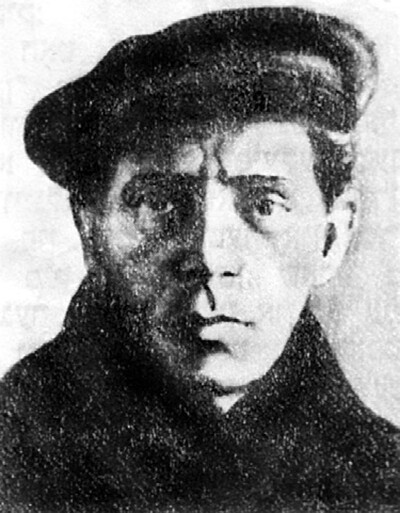
Lev, Ziskind
1896-summer 1937
He was a poet, prose author, and playwright, born in Zhedishev, near Reyshe (Rzeszów), western Galicia. He attended religious elementary school, a Polish public school, and later became a carpenter.
In August 1914, when WWI broke out, he volunteered to join the Austrian army and served at the front until 1918. In 1919 he returned to Vienna, was an employee at Jüdische Morgenpost (Jewish Morning Mail), and in 1920 left for Berlin where he joined the Communist Party and was later active in the leftist movement in Poland, Austria, and Germany.
His writing activities began (using the pen name Zishe-Leyb) with poetry in Lemberg’s Togblat (Daily Newspaper) in 1914, later also writing stories and articles.
Fate brought him to Galicia, and he became a professional journalist, publishing in the Communist Literarishe Tribune (Literary Tribune) (Lodz-Warsaw, 1925-1931), contributing as a co-editor to Dos Vort (The Word) (Cracow, 1931), and other serials. He co-edited (with M. Naygreshl) the publication Yidish (Yiddish) in Vienna (1928); and he contributed poetry and stories to Literarishe Bleter (Literary Newspaper) in Warsaw (until 1932) and to the newspaper Tsushtayer (Contribution) in Lemberg (1931-1932). From 1930 he was a regular contributor to Morgn-Frayhayt (Morning Freedom) in New York, in which he published the novels, Getsl Safrans Veg tsu der Revolutsye (Getsl Safran’s Path to the Revolution) (1931) and Der Oyfshtand fun Shvyenta Sarne (The Uprising of Shvyenta-Sarne) (1932), a series of reportage pieces entitled “Vos ikh hob Gezen in Galitsye” (What I Saw in Galicia), stories, and articles. He also wrote for the Communist magazine Hamer (Hammer)—in which he published his novel Andrey un der Pop (André and the Priest)—Signal (Signal), and other serials in New York.
From 1931 he was living in the Soviet Union, where he settled in Minsk. He participated in meetings of Jewish and general Soviet writers’ conferences in Minsk. The Soviet period in his writing began happily, as the Yiddish publications opened for him a new and broad realm in which he was able to realize his creative plans. Literature became his sole field of work.
In Soviet Russia he was a regular contributor to the editorial board of Oktyabr (October) and Shtern (Star) in Minsk—in which he published portions of a novel entitled Tshvishn Zbrutsh un Dnyester (Between the Zbruch and the Dniester [Rivers]); Der Emes (The Truth) in Moscow, in which among other items he published in 1934 “Di Proletn fun Berlin” (The Proles of Berlin); the collection Sovetish (Soviet) in Moscow, in which in 1934 he placed his long story “Frants Kanotop Farkoyft zayn Zun” (Frantz Kanotop Sells his Son); and In Shotn fun Tlies, Almanakh fun der Yidisher Proletarisher Literatur in di Kapitalistishe Lender (In the Shadow of the Gallows, an Almanac of Yiddish Proletarian Literature in the Capitalist Countries) (Kharkov-Kiev: Ukrainian State Publishers for National Minorities, 1932); among others.
He also tried his hand at playwriting and with great success. His play in three acts, Der Shtrayk fun di Shniter (The Strike of the Harvester), was staged in 1935 in the Artef Theater in New York; later, after his death, it was published in Vilna (1939).
On the tenth anniversary of the journal Shtern in Minsk in 1935, he published therein the first part of his story “Fishl Kopytshik un Petre Yeremtshuk” (Fishl Kopchik and Petre Yeremchuk), a remembrance of WWI and class struggle, the primary theme of his entire oeuvre.
Meanwhile, a chase began after foreign Communists who were connected to the Comintern and who thought that they had been saved from the fascist hangman in the “land of the Reds.” At the Jewish writers’ meeting in Minsk (March 1937), a number of speakers fiercely attacked him, and one publicly said that “in the Yiddish literature of Byelorussia, an agent of the Gestapo had sneaked in: Ziskind Lev” (Oktyabr 121, March 1937). He was arrested in late 1936 at a time when he was living in a country house near Moscow and working on a book for the Moscow publisher Der Emes (The Truth
From that time there was no news from or about him. According to unconfirmed rumors, he died in a camp somewhere in the Pechora wilderness.
In book form he published: (using the pen name Yoysef Tishler), Der Videroyfboy fun Erets-Yisroel (The Reconstruction of the Land of Israel) (Vienna, 1919), 32 pp.; Poyln, a sHekhthoyz far Mentshn (Poland, a Slaughterhouse for Men), a portion of which appeared in Morgn-Frayhayt (Morning Freedom) in New York, with a foreword by P. Novik (New York: Byalisṭoker, Novi-Dvorer un Tsenstokhoṿer Hilfs-Komiṭeṭn tsu Shtistsn di Politishe Arestirte in Poyln, 1933), 72 pp.; Fir Mentshn Zukhn di Revolutsye (Four Men Search for the Revolution), a novel in four parts (Minsk: Byelorussian State Publishers, 1933), 172 pp.; Fun Velt tsu Velt (From World to World), stories (Moscow: Emes, 1936), 342 pp.; and German Fridberg, a play in Russian (Moscow, 1936).
He published under the pen name “Ziskind Leyb” as well.
“His fictional writings,” noted M. R., “excelled with raw, primitive naturalism—and an intuitive, artistic graphic quality.”
Sources: Shmuel Niger, in Der Tog (New York) (January 18, 1931; December 28, 1931); B. Fenster, in Morgn-Frayhayt (New York) (January 26, 1931; March 28, 1931; May 2, 1931); Moyshe Nadir, in Morgn-Frayhayt (April 2, 1932); H. Reminik, in Shtern (Kharkov) 244 (1934); M. Litvakov, in Der Emes (Moscow) 234, 236 (1934); D. Kurland, in Shtern (Minsk) 6 (1934); A. Pomerants, in Proletpen (Kiev) (1935), p. 89; Pomerants, in Signal (New York) (April 1936); M. Olgin, in Morgn-Frayhayt (October 13, 1935); V. Edlin, in Tog (October 16, 1935); H. Vaynraykh, Blut af der Zun (Blood on the Sun) (New York, 1950), p. 64; N. Y. Gotlib, in Keneder Adler (Montreal) (March 30, 1953); Dr. M. Naygreeshl, in Fun Noentn Over (New York) 1 (1955), p. 390; N. Mayzil, Dos Yidishe Shafn un der Yidisher Arbeter in Sovetn-Farband (Jewish Creation and the Jewish Worker in the Soviet Union) (New York, 1959), see index; Chone Shmeruk, comp., Pirsumim yehudiim babrit-hamoatsot, 1917-1961 (Jewish Publications in the Soviet Union, 1917-1961) (Jerusalem, 1961), see index.
ZISKIND LEV's novel Andrey un der pop (André and the priest) was also published in Literarishe khrestomatie :farn VII lernyorn fun der politekhnisher shul /tsunoyfgeshtelt - O. Holdes un F. Shames. Tsveyte oysgebeserte uflage. - Kharkov;Kiev : Melukhe-farlag far di natsionale minderhaytn in USRR, 1934.- 327, [1] pp.
ליטערארישע כרעסטאמאטיע:
פארנ 7 לערניאר פונ דער פאליטעכנישער שול
צונױפגעשטעלט - א. האלדעס אונ פ. שאמעס
צװײטע אויסגעבעסערטע אופלאגע
כארקאװ;קיעװ : מעלוכע-פארלאג פאר די נאציאנאלע מינדערהײטנ אינ אוסרר
1934