
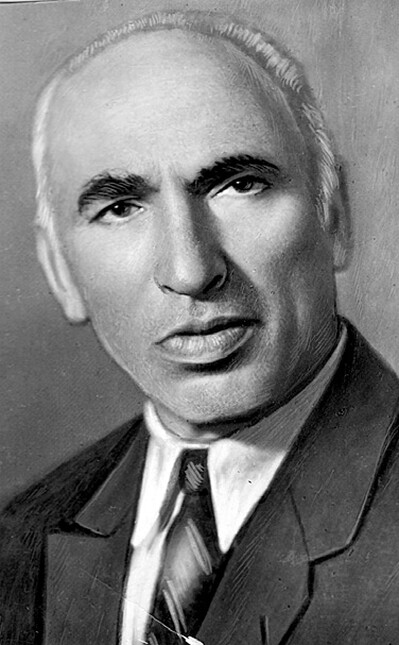
Lifshits, Mendl
January 14, 1907–May 10, 1983
He was a poet, born in the village of Nestanovitsh (Nestanovichi), Byelorussia. He attended religious primary school and public school, later graduating from Byelorussian State University.
He debuted in print with poetry from 1923 in Yiddish periodical publications in Minsk and Moscow, contributing work to anthologies and almanacs. The main themes of his poetry were social lyrical works and philosophical deliberations.
His poems appeared in the Minsk poetry anthologies Kep (Heads) (Byelorussian State Publishers, 1926) and Sovetishe Vaysrusland, Literarishe Zamlung (Soviet Byelorussia, Literary Collection) (Byelorussian State Publishers, 1935); Shtern (Star); Atake, Almanakh fun Roytarmeyishn Landshuts-Literatur (Attack, Almanac of the Red Army’s National Defense Literature) (Byelorussian State Publishers, 1934), Tsaytshrift (Periodical), Oktyabr (October), the literary collection Di Bafrayte Brider (The Liberated Brothers), and Moscow’s Emes (Truth), among others.
Until 1941 he lived in Minsk, where he was one of the most capable builders of Yiddish literature in Byelorussia. He was employed there in the general writers’ union as a consultant on manuscripts sent in by young writers.
Over the years 1941-1944, he was evacuated and lived in Samarkand, Uzbekistan. In 1945 he settled near Moscow in the city of Krasnogorsk, and there he contributed poetry to the newspaper Eynikeyt (Unity). He also published in numerous publications outside Russia.
His first published booklet appeared in 1932 in Minsk, and thereafter he produced a number of poetry collections both in the original Yiddish and in Byelorussian and Russian translations.
These were sincere poetic and lyrical reactions and reverberations to the most important historical events of the epoch, to the boisterous 1930s in the life and the land of a people. In the 1930s he was often attacked for romanticism, individualism, and for remembering the terror of pogroms too much.
He later avoided the fate of his murdered comrades under Stalin. Literary critics noted how authentic an artist Lifshits was, always independent and original in his poetic visions, innovative, and novel in describing the life events, rigorously individual in poetic language, frugal in poetic word.
A substantial place in his creative work was occupied by children’s poetry. He also translated a series of works of Byelorussian and Russian poetry into Yiddish.
He was last living in Moscow [a/o 1963].
His poetry was also represented in Sovetish Heymland (Soviet Homeland) 2 (1961) and 3 (1962).
He authored the books: Mit Heysn Trop (With Fervent Step), poetry (Minsk, 1932), 60 pp.; Mayne un Ayere Lider (Mine and Your Poems) (Moscow-Kharkov-Minsk: Central Publishers, 1934), 75 pp.; Lider (Poetry) (Minsk: State Publ., 1934), 113 pp.; Yunge Yorn, Poeme (Youth, a Poem) (Minsk: State Publ., 1935), 71 pp.; Naye Lider (New Poems) (Minsk: Byelorussian State Publishers, 1936), 92 pp.; Feter (Uncle), poetry (Minsk, 1936), 42 pp.; Mit Alemen Tsuzamen, Lider (With Everyone Together, Poetry) (Minsk: Byelorussian State Publishers, 1939), 112 pp.; Hozikhe (Minsk, 1939), 8 pp.; Unter a Mazldikn Shtern (Under a Lucky Star), poetry (Minsk: State Publ., 1940), 155 pp.; Iber Toyzent Verstn (Over a Thousand Versts) (Moscow, 1947), 112 pp.; Ba zikh in der Heym, Geveylte Lider (By Oneself at Home, Selected Poems) (Moscow: Sovetski Pisatel, 1967), 167 pp.; A Zun Mit a Regn (A Sun with Rain) (Moscow: Sovetski Pisatel, 1977), 174 pp.; and a number of volumes of poetry in Russian.
He translated into Yiddish: Aleksander Barta, A Yingele Farkert (A Little Boy Turned All Around) (Minsk: Byelorussian State Publishers, 1935), 20 pp.; and V. V. Ivanov, Pantsertsug 14-69 (Armored Train 14-69 [original: Bronepoezd 14-69]) (Minsk: Byelorussian State Publishers, 1938), 126 pp.
Sources: B. Orshanski, in Tsaytshrift (Minsk) 5 (1931); L. Tsart, in Shtern (Minsk) (March 1932); V. Vitkin, in Shtern (September 1932); Kh. Dunyets, in Shtern (December 1932); A. Kushnirov, in Naye Prese (Paris) (July 27, 1945); Y. Dobrushin, in Heymland (Moscow) 2 (1947); M. Lastik, in Yidishe Shriftn (Lodz) (November 1948); N. Y. Gotlib, in Tsukunft (New York) (May 1951); Y. Katsenelson, in Morgn-Frayhayt (New York) (March 12, 1956); M. Kats, in Morgn-Frayhayt (May 26, 1957); N. Mayzil, Dos Yidishe Shafn un der Yidisher Arbeter in Sovetn-Farband (Jewish Creation and the Jewish Worker in the Soviet Union) (New York, 1959), see index; S. Rabinovitsh, in Folks-Shtime (Warsaw) (February 6, 1960); Chone Shmeruk, comp., Pirsumim yehudiim babrit-hamoatsot, 1917-1961 (Jewish Publications in the Soviet Union, 1917-1961) (Jerusalem, 1961), see index; B. Ts. Goldberg, in Tog-Morgn-Zhurnal (New York) (January 9, 1962); Folks-Shtime (January 3, 1962); Y. Lyubomirski, in Sovetish Heymland (Moscow) 6 (1962).
Mendl Lifshits translated from Belorussian into Yiddish Ales' Yakimovitsh's Der umgeveynlekher ber: dertseylung (orig.: Незвычайны мядзведзь/Необыкновенный медведь/ Unusual bear).- Minsk : Melukhe-farlag fun Vaysrusland. Natssekter, 1935.- 63,[1] pp.; [12] ill.
דער אומגעװײנלעכער בער
א. יאקימאװיטש; איבערזעצט פונ װײסרוסיש - מ. ליפשיצ
Hozikhe=doe-hare=female hare=Зайчиха
The correct name of the Russian author of "A yingele farkert" (Malchik naoborot = A vice versa boy) is Agniya Lvovna Barto (1906-1981)/Барто, Агния Львовна
א יינגעלע פארקערט
א. בארטא; יידיש - מ. ליפשיצ
Among his books for children is an illustrated one "Hozikhe" (Minsk, 1939.- 8 pp.)
האזיכע