Leksikon fun der Nayer Yidisher Literatur
לעקסיקאָן פֿון דער נײַער ייִדישער ליטעראַטור

Browse All People
By Subjects
By Volume:

search tips
✕
≡

How to Build Your Search:

A. In the below “Advanced Search,” use the drop down parameters under "Scope" - ALL words, ANY words, or EXACT word/phrase. Build the parameters row by row.


OR


B. To define your search using the basic one-line search, in the above textbox:

  • Use a plus to REQUIRE the word:
    +music +theory << must contain the words music and the word theory
  • Use quotes for a phrase:
    song "music theory" << anything with song or phrase "music theory"
    or "levin" < exact match, not levine
  • Use + and quotes to require the phrase:
    +"music theory" << must include phrase
  • Use a minus to EXCLUDE:
    +music -theory << must include music, but not theory
NOTE: When searching in Yiddish letters, this Lexicon should find the word(s) with or without diacritics (e.g., אברהם vs. אַבֿרהם) -- but when searching in other systems, if you can't find it one way, try searching the other way.
⋮⋮
⋮⋮
Search:
Text
Dates
Subjects
Living People ONLY
Women ONLY
Records w/ Images ONLY
Search in:
Scope:
ALL words
ANY words
EXACT word/phrase
א אַ אָ ב בּ בֿ ג ד ה ו װ ױ ז ח ט י יִ ײ ײַ כ כּ ך ל מ ם נ ן ס ע פּ פֿ פ ף צ ץ ק ר ש שׂ תּ ת ־

click for image pop-out

Image from Beider lexicon; see citation.

Click, drag, enlarge the below information boxes. (Then click the arrow in upper right to return them to their place & size.)
Images (click an image for slideshow)


Image from Beider lexicon; see citation.


Lexicon Books
Credits
  • Chaim Beider
  • Joshua Fogel
  • Tetiana Shyshkina
  • Shoshke-Rayzl Yuni
  • Mark H. David
  • Also See
    •

    Shulman, Moyni

    1911–1994

    approx. 82 - 83 years

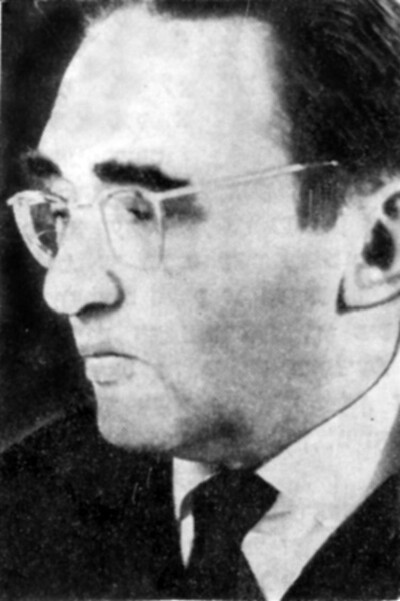
    He was an editor and translator, born in the town of Beremlia (Boremel'), Ukraine. In his childhood, he survived the pogroms that took place in his hometown, and they were forever engraved in his memory. The family moved to Uman, and there he grew up and spent his youthful years. After graduation from a seven-year Jewish school, he proceeded to enter the Uman technical construction school, but he did not graduate. In Kharkov he published his first notes and articles, and the editorial board of the Kharkov newspaper Yunge Gvardye (Young Guard) invited him in 1930 to work for it on a regular basis. He worked there until 1936 when the newspaper was closed down. From 1937 he began working for the Kiev newspaper Der Shtern (The Star). In 1940 the editorial board assigned him to be a special correspondent in Lviv, where the newspaper Der royte shtern (The red star) had commenced publication, and he served there as the actual editor-in-chief. In late June 1941, he published the last number of this newspaper (one day before the Germans occupied the city), returned to Kiev, and from there soon enlisted in the army. He was demobilized at the rank of lieutenant, and in July 1947 he came to work in Moscow for the newspaper Eynikeyt (Unity), for which he directed a division until the newspaper was discontinued on November 21, 1948. Concerning his work at Eynikeyt and its being shut down, he later wrote up memoirs and published them in the final issue of Sovetish Heymland (Soviet Homeland) 11-12 (1991). From 1961 he was editor of prose for Sovetish Heymland. He later edited prose volumes which were published in Moscow by Sovetski Pisatel. His major work was the definitively edited publication of the great Russian-Yiddish dictionary which appeared in print in 1984: Russko-evreiskii (idish) slovarʹ, okolo 40.000 slov (Russian-Yiddish dictionary, close to 40,000 words) (Moscow: Russkyi yazik, 1984), 719 pp.

    Chaim Beider, Leksikon fun yidishe shrayber in ratn-farband (Biographical dictionary of Yiddish writers in the Soviet Union), ed. Boris Sandler and Gennady Estraikh (New York: Congress for Jewish Culture, Inc., 2011), pp. 379-80.

    •

    © 2026 Congress for Jewish Culture 
    Rights are reserved. If you wish to quote small portions of text or data from this Lexicon, you may do so with full attribution to the Congress for Jewish Culture and a link to the specific site, which credits the sources. The Lexicon is perpetually in process; so some elements cited might change as we correct and update information.

    If you notice any errors or omissions in this Lexicon (or if you have any concerns or need help) please email us -- Or feel free to post a Public Comment, form at the end of each person's biography.

    NOTE
    A lot of our English and Yiddish texts and metadata are being worked on: researched, checked, corrected, fixed, formatted, updated, and translated.
    There are many ways you can help.

    Your Comment *
    Reminder - Please state your Source of info in your comment
    You will get an email for verification before your comment is put on the site. We will not make your email address public.