
Shteyman, Beynush
1897–August 31, 1919
He was a poet and playwright, born in Kreslavke (Krāslava), Vitebsk Province. He often published under the name Shteynman. His father was a poor baker. He attended religious elementary school, completed middle school in Kreslavke in 1914, passed the examinations for a pharmacist’s assistant, and until 1916 worked in a Vilna pharmacy. He then returned to Kreslavke and founded a public school and a drama circle there. He went on to study at the Kharkov teachers’ seminary.
In late August 1919 he came to Kiev, and no sooner was he mobilized into defensive work, than he was killed. He died in Slobodka, a suburb of Kiev.
He wrote poetry and dramas, but all were published after his premature death. Many of his poems were published in Sovetish Heymland (Soviet Homeland). He was the author of four dramas, collected in:
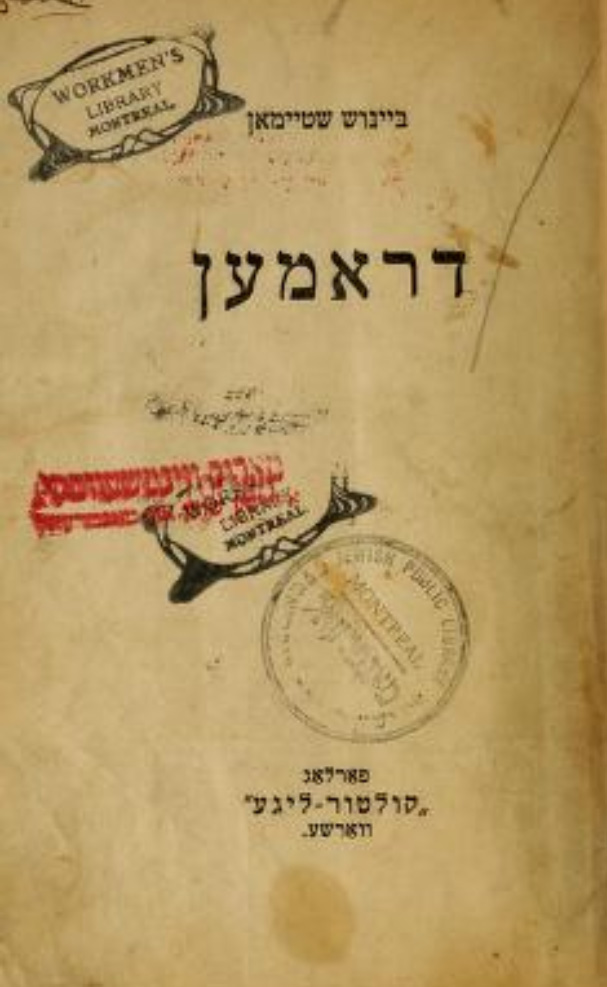
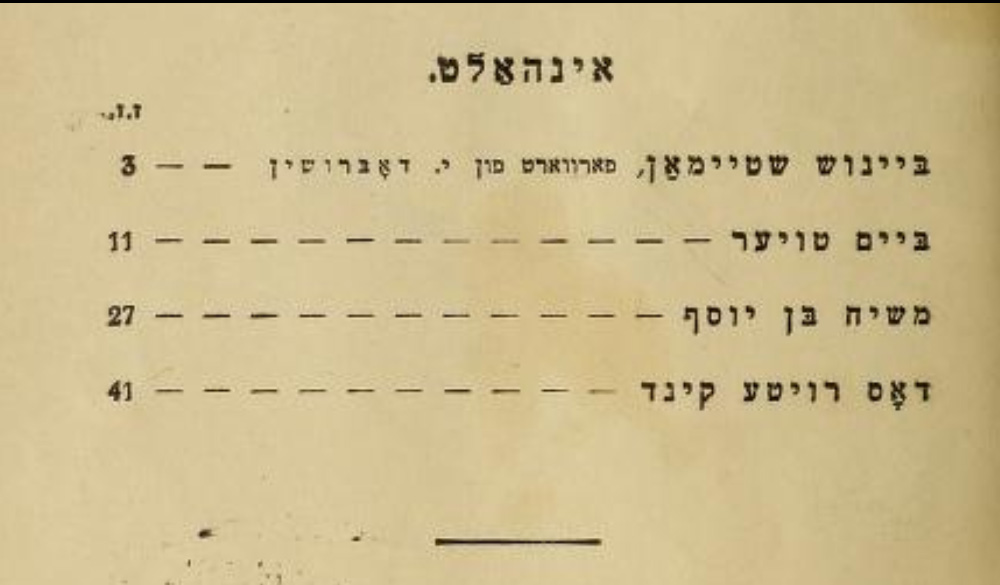
Dramen fun Beynush Shteynman (Dramas by Beynush Shteynman) (Warsaw: Kultur-Lige, 1921), 65 pp., second edition (Warsaw, 1922), with a biographical introduction by Y. Dabrushin.
And published separately:
Baym Toyer, a Dramatisher Kholem (At the Gate, a Dramatic Dream), in Oyfgang (Arise) (Kiev) (1919);
Meshiekh ben Yoysef, Dramatishe Poeme (Messiah Son of Joseph, a Dramatic Poem), in Eygns (One’s own) (Kiev) II (1920), published separately (Kiev: Kultur-Lige, 1920), 7 pp.;
Dos Royte Kind, Drame in Dray Aktn (The Red Child, a Drama in Three Acts), from the cycle “Geule” (Redemption), in
His fourth play, In Hoyf (In the Courtyard), was lost.
In the journal Vispe (Islet) (Kovno) 1 (1923), there was published a translation by Shteyman of
Oscar Wilde, Shulamis (Shulamith [original: Salome).
He also translated
Wilde’s Dos Bild fun Doryan Grey (The Picture of Dorian Gray), but it is unclear if it was ever published.
His Mekhiekh ben Yoysef was staged in 1926 in New York with music by Yankev Sheyfer and the participation of the New York Symphony Orchestra.
“With the tragically killed Shteyman,” wrote Zalmen Reyzen, “is lost one of the best hopes of modern Yiddish playwrights…. The psychological tact, the concentration of his treatment, the construction of the mass scenes, the fine and poignant nuancing of dialogue, and the intellectual scope of his dramatic poems…make him one of the most original of Yiddish playwrights.”
“The organically unified form and content,” noted Yekhezkl Dobrushin, “which are poured into a genuine scenic mold, the rigidly picturesque, objectively hardened mass dialogue...—in all these lies the guarantee that in Beynush Shteyman the spirit of modern Yiddish playwriting had begun to develop…[and] it supplies the hidden possibility of the worth of the modern Yiddish theater.”
Sources: Zalmen Reyzen, Leksikon, vol. 4; Chone Shmeruk, comp., Pirsumim yehudiim babrit-hamoatsot, 1917-1961 (Jewish Publications in the Soviet Union, 1917-1961) (Jerusalem, 1962), see index; Yekhezkl Dobrushin, Gedankengang (Reasoning) (Kiev, 1922), pp. 127-31; Nokhum Oyslender, Veg-ayn-veg-oys, literarishe epizodn (Way in, way out, literary episodes) (Kiev, 1924); Zev Volf Latski-Bertoldi and Nakhmen Mayzil, in Literarishe Bleter (Warsaw) 35 (1929); Shmuel Niger, Yidishe shrayber in sovet-rusland (Yiddish writers in Soviet Russia) (New York, 1958), pp. 9-14; Itshe Goldberg, Undzer dramaturgye, leyenbukh in der yidisher drame (Our playwriting, textbook in Yiddish drama) (New York: IKUF, 1961), p. 321; Sovetish Heymland (Moscow) 8 (1867); Aleksander Pomerants, Di sovetishe haruge malkhes, tsu zeyer 10-tn yortsayt, vegn dem tragishn goyrl fun di yidishe shraybers un der yidisher literatur in sovetnland (The [Jewish writers] murdered by the Soviet government, on their tenth anniversary of their deaths, concerning the tragic fate of the Yiddish writers and Yiddish literature in the Soviet Union) (Buenos Aires: YIVO, 1962), p. 494; Yeshurin archive, YIVO (New York).