


Naydus, Leyb
October 6, 1890–December 23, 1918
He was born in Grodno, Russian Poland, into a wealthy family somewhat accommodated to the Jewish Enlightenment. The father, a landowner and factory entrepreneur, was in his youth interested in Hebrew literature and even wrote Hebrew poetry. In Grodno the family was provisionally ready to give the children an appropriate education, and later the family moved back to Kustin (Kuscin), not far from Grodno, which was the standing residential site of the Nayduses since 1870. There he was raised in princely comfort until he reached age ten—under the supervision of his Enlightened father and—what’s more—his perceptive mother and good-hearted grandmother, a Tsenerene Jewess with deep love in her nature. His initial general and Jewish education came by way of home tutors and in elementary school in Grodno. At age eleven he entered a commercial school in Radom, later in a similar school in Bialystok, from which he was expelled in 1905 for participating in a movement of socialist territorialists. Around 1908 he entered Pavlovski’s senior high school in Vilna. Evincing no excessive yearning for the subject matter, in 1911, before finishing school, he left and turned his attention entirely to poetry.
He had begun writing in Hebrew, Russian, and Yiddish at age ten. A number of his Russian poems were published in various newspapers and magazines in Vilna and Grodno. From that period there remains a collection of poems entitled
Poleviia Panna (Young Lady of the Field).
His publishing debut in Yiddish took place
in 1907 in issue 32 of the Warsaw-based Roman-Tsaytung (Fiction Newspaper)—with the poem “Di Yunge Harfe” (The Young harp)—
and later he published original poems and translations in
Leben un Visenshaft (Life and Science),
Y. L. Perets’s Yudish (Yiddish),
Avrom Reyzen’s Dos Naye Land (The New Country) and
Parizer Zhurnal (Parisian Journal),
Shmuel Niger’s Di Yudishe Velt (The Jewish World), and elsewhere.
He also wrote light humorous pieces in verse and in prose (under pen names such as: Leybke Reykhls, Leonardo, and Lolo) in
Vilner Vokhenblat (Vilna Weekly Newspaper) and
later also in Di Letste Nayes (The Latest News).
In 1915—with help from his friend Y. Ovtshin, in Ekaterinoslav, where he was living during the years of WWI—he published his first book of collected poems, entitled
Lirik (Lyric) (Vilna, 1915), 160 pp.
Through the war and the German occupation, Naydus was unable to distribute the book, and his first serious piece of literary work remained without any response. Such was the case later in his life, for he was not destined to hear a word of encouraging criticism or recognition. The young poet had to be satisfied with the echoes among the young, for whom he appeared at recitations of their own work and later as well as a speaker on literary topics—so-called “Estetishe Ovntn” (Aesthetic Evenings).
Naydus translated Pushkin’s stories for the new Yiddish schools. His translation of
Pushkin’s A Mayse Mit a Toyter Bas-Malke un Zibn Giboyrim (A Story with a Dead Princess and Seven Rich Knight [original: Skazka o Myortvoy Tsarevne i o Semi Bogatyryakh (The Tale of the Dead Tsarevna and of the Seven Bogatyrs)]) was published by the Y. L. Perets Teachers’ Committee (Vilna, 1917), edited by Zalmen Reyzen—republished (Warsaw: Kinder-fraynd, 1938), 31 pp.
That same year (1917), Naydus published in Grodno the literary collection
Nyeman (Neman [River]) and
in 1918 a short anthology of nature poetry entitled
Di Fleyt fun Pan (Pan’s Flute) (Grodno, 46 pp.).
“This poem,” noted Avrom Zak, “is a symphony to spring. Forty eight-line poems, twisted together one with the next, sun and colors binding them together. These constitute forty light, winged chapters of an intimate spring diary, inspired by spring dew…. The poet found great fortune in this earlier, boundless, eternally thriving, and eternally youthful dominion of the field- and forest-deity, ‘Pan.’”
He prepared for publication his short collection,
Intime Nigunim, Lider (Intimate Melodies, Poetry), but it was his close friends who brought it out in 1918 or 1919, after his death, in Grodno (38 pp.).
The poems in this collection were an express departure from his regular rhythm and gauge of verse; the poet packed them with another rhythm, an internal, a hidden intimacy. The whimsical lack of discipline is compensated by intimate and lyrical beauty which blows out of these experimental poems.
Naydus reached the highest level of his plastic maturity in his poetry in
Di Erd Dervakht (The Earth Awakens), composed in the last spring of his life in Kustin (May 1918) and published in book form by Tsisho (Central Jewish School Organization) in Vilna (ca. 1925), 13 pp.
The poet himself labeled the poem with the subtitle “Poetishe Sonate” (Poetic Sonata). This was actually a deep expression of joy, intoxicated and infused with nature in its entirety. Every verse sputters with freshness, with the scent of fermented earth, with passion and birth….
Then, however, Naydus began to feel ill. The doctors discovered that he was suffering from heart neurosis and advised him to interrupt his writing for a time and go take a good rest, but he did not want to sit in his home. He exerted himself excessively in the city in the evenings, paying visits to people, giving lectures, and attending to his literary work. When his strength was depleted, he returned home, lay in bed, and lacked the strength to so much as speak. But when his health improved just a bit, he went back to the city and led the life of a Bohemian. His mood was highly depressed. Friends told him that he was dangerously sick and that he would soon die. And he would thus rush to get more written down.
So that no one would be able to restrict him from work, he found a room of an old Jew, into which no one was allowed to come, and he was thus able to be entirely alone. His mood, though, did not improve because of this. The loneliness, breaking off contacts with literary surroundings, and especially separation from his beloved (Miss Kh. N., a student, who incidentally had a major influence on him, and thanks to her, he completely switched to writing in Yiddish; she was herself an ill woman, departed for Switzerland, and died there two months after Naydus’s own death). All of this hit the delicate, joy-embracing poet hard, and the premonition of approaching death found expression in a series of poems. An acute crisis took place in the last months of his life—late summer 1918, during the German occupation. From too much work and exertion, from too much traveling around giving lectures through the nearby cities and town. He was then giving talks on:
“Vegn der Yidisher Poezye” (On Yiddish Poetry) and
“Perets un Sholem-Aleykhem” Perets and Sholem-Aleykhem),
and in general his overall lifestyle wrought havoc with his health. He took refuge in Kustin for a bit of familiar rest, but there as well he spent the entire day sitting over books and manuscripts, mainly working intensely on his poetic rendition of
Pushkin’s Yevgeniy Onegin.
He was also preparing his spiritual poems,
Di Intime Nigunim.
He had completed them, but had not as yet had time to submit them to the publisher. When he returned to Grodno from his last tour, Naydus completely collapsed. En route home, he caught a cold and was hoarse. He lay in bed “for laughter,” not even allowing any doctors to call, but substituting some sort of homegrown old-style barber-surgeon. On a chair by his bed sat his completed manuscripts with nicely composed frontispieces:
Litvishe Arabeskn (Lithuanian Arabesques),
Dos Bukh fun Poemen (The Book of Poems),
Intime Nigunim, and
his translation of Baudelaire’s Blumen fun Shlekhts (Les Fleurs du Mal), among others.
At this point a sharp change occurred: he became severely ill with diphtheria. He was taken to a clinic, but it was already too late, as his weakened heart could not endure. The city was enveloped in sadness—all came to pay their respects to their beloved poet. On Naydus’s gravestone, there is an angelic figure with its head facing downward and painful, doubled-up wings (the creation of the sculptor Abraham Ostrzega, who later died a martyr’s death).
Naydus’s complete works were to be published after his death. In 1923 the brothers Levin-Epshteyn, following the good offices of the Naydus Committee which was connected to the Association of Yiddish Writers and Journalists of Warsaw, proceeded to publish only the first volume,
Dos Bukh fun Poemen (216 pp.);
the second volume, Litvishe Arabeskn, came out with the publisher Sh. Yatshkovski (Warsaw, 1924), 19 + 365 pp., with a biographical note by Avrom Zak—including
Litvishe Arabeskn,
the full cycle of “Lite-Peyzazhn” (Lithuanian Countrysides),
Di Fleyt fun Pan,
Intime Nigunim,
“Mayn Folk” (My People),
“Mizrekhdiks” (Easterners), and
“Fun Briv” (From Letters).
With the transition from Yatshkovski publishers to Bzhoza, there were published from the planned “complete works”:
Rusishe Dikhtung, Pushkin un Lermontov (Russian Poetry, Pushkin and Lermontov) (Warsaw, 1926), 375 pp.:
41 poems by Aleksandr Pushkin,
four chapters from Pushkin’s novels in verse, Yevgeniy Onegin and Skazka o Myortvoy Tsarevne i o semi Bogatyryakh, and
43 poems by Mikhail Lermontov;
Lirik (1926), 419 pp.;
Shnirlekh Perl (String of Pearls)—various and sundry items, poetry, miniatures, articles, features, and the like;
Fun Velt-Parnas (From the World Parnassus) (1928), 234 pp.—
Baudelaire’s Blumen fun Shlekhts and
an anthology of French lyric, including Paul Verlaine, Théophile Gautier, Maurice Maeterlinck, Edmond Rostand, Alfred de Musset, Leconte de Lisle, and others,
as well as cycles of poetry by Emile Verhaeren, Georges Rodenbach, Heinrich Heine, Arthur Schnitzler, Martin Greif, Goethe, Shelley, Edgar Allan Poe, and Richard Dehmel, among others.
Naydus filed, polished, and rendered faithful the Judaizing of Pushkin’s verse to fit Pushkin’s rhythm, and he strove so that no nuance would be lost in the translation. Later a volume of his, entitled
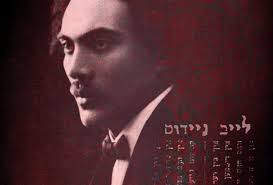
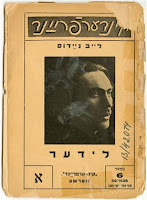
Lider (Poems), was published by “Kinderfraynd” (Children’s friend) in 1938 (46 pp. [see below]).
Later still:
Oysgeklibene Shriftn, Lider Mid Nigunim tsu Lider, Fragmentn fun Forsh-Arbetn tsu di Kharakteristik un Zikhroynes (Selected Writings, Poems with Melodies for the Poems, Fragments of Research Work on Their Character and Memoirs), introduced and edited by Shmuel Rozhanski, with essays by Avrom Zak and a fragment from Shmuel Niger’s assessment (Buenos Aires: Congress for Jewish Culture, 1956), 199 pp.
The poet Avrom Zak, with partial assistance from H. L. Zhitnitski, edited Naydus’s
Gezamlte Shriftn (Collected Writings) in six volumes, which appeared between 1923 and 1926:
Lirik,
Litvishe Arabeskn,
Dos Bukh fun Poemen,
Shnirlekh Perl,
Rusishe Dikhtung, and
Fun Velt-Parnas.
“His poems…were a kind of song above world poetry,” wrote Yankev Glatshteyn, “not an imitation, but a conquest, a demonstration that one could or that one alone could accomplish everything with Yiddish poetry. In the eleven years that he wrote and also translated from world poetry, this young man from Grodno revealed that our potential in the realm of uncovered Yiddish poetic diction had until him remained in the nooks and crannies.”
“In the beginning it seemed,” noted Shmuel Niger, “that his talents were purely external. He wrote things too agilely, too easily…. But he soon took up with his own hands and plunged into the main problem, with which the new school of poetry in Russia was concerned and which for him alone, according to his character, was personally important—this was the issue of rhythm, form, and technique. In this field he truly made significant accomplishments. He introduced to the Yiddish lyric new rhythms, rhymes, words, and subjects…. Mastery of form for him was neither a goal nor a means, but what it constituted in each true poetry: a bit of language found in silence from an overflowing soul, a radiant internal clarity…. At the time, Naydus gave Yiddish poetry not only new, unknown rhythms, and not only new, “elegant” subject matter, but also a new bit of real, vibrant lyric. And, together with other young Yiddish lyricists in Russia, America, and Galicia, he helped “Europeanize” and refine Yiddish poetry from within, not only from without.”
Sources: Zalmen Reyzen, Leksikon, vol. 2, with a bibliography; Lita (Lithuania), anthology, vol. 2; Avrom Zak, in Unzer Vinkl (Grodno) (May 1919); Zak, in Di Tsukunft (New York) (October 1958), pp. 400-4; Zak, in Oysgeklibene Shriftn (Selected Works) (Buenos Aires, 1958), pp. 25-46; Zak, In Onhoyb fun a Friling (At the Beginning of a Spring) (Buenos Aires, 1962), see index; Shmuel Niger, in Di Tsukunft (July 1920; January 1927); Y. R. (Rapaport), in Bikher-Nayes (Warsaw) (March-April 1927); Y. R., in Bikher-Velt (Warsaw) (May 1928); M. Kitay, in Literarishe Bleter (Warsaw) (December 27, 1929); Kitay, Unzere Shrayber un Kinstler (Our Writers and Artists) (Warsaw: Jewish Universal Library, 1938), pp. 107-11; B. Y. Byalostotski, Lider un Eseyen (Poetry and Essay) (New York, 1932), pp. 79ff; P. Shteynvaks, in Haynt (Warsaw) (January 25, 1935); D. Tsharni (Daniel Charney), in Di Tsukunft (October-November 1935); Charney, A Yortsendlik Aza, 1914-1924, Memuarn (Such a Decade, 1914-1924, Memoirs) (New York, 1943), pp. 22-24; Charney, A Litvak in Poyln (A Lithuanian Jew in Poland) (New York, 1955), pp. 42-43; A. Pomerants, in Der Hamer (New York) (December 1938); Pomerants, in Fraye Arbeter-Shtime (New York) (December 18, 1953); Pomerants, in Forverts (New York) (February 1, 1959); Sh. Tanenboym, in Literarishe Bleter (December 30, 1938); Tanenboym, in Nyu Yorker Vokhnblat (New York) 439-440 (1952); Tanenboym, in Di Shtime (Mexico City) (May 4, 1963); Rashel Naydus and Sh. Kahan, in Vilner Tog (Vilna) (December 23, 1938); “Naydus Baylage” (Naydus Supplement), Moment (Warsaw) (January 13, 1939); M. Daytsh, in Literarishe Zamlungen (Chicago) (1944); D. Sherman, in Grodner Opklangen (Buenos Aires) 1 (1948), p. 8; Y. Radin in Grodner Opklangen 2 (1949); Yankev Glatshteyn, in Idisher Kemfer (New York) (March 6, 1959); Glatshteyn, In Tokh Genumen (In Essence), vol. 1 (Buenos Aires, 1963), pp. 147-54; A. Mendelevitsh, in Folk-Shtime (Warsaw) (October 6, 1960); Meylekh Ravitsh, in Keneder Adler (Montreal) (December 25, 1961); Leyb Naydus Biblyografye (Leyb Naydus Bibliography) (Buenos Aires, 1962), 10 pp., also as a separate offprint from Grodner Opklangen 14; Moshe Basok, Mivḥar shirat yidish (Selection of Yiddish Poetry) (Tel Aviv, 1963), pp. 153-54.
Poetry by Leyb Naydus was published in the 3d part of the reader "Arum undz: khrestomatie in 3 teyln" (Around us), compiled by E. Spivak.- Kiev: Kooperativer farlag Kultur-Lige, 1927.- 314, [5] pp., ill., photo.
ארום אונז: כרעסטאמאטיע אין 3 טײלן
געשטעלט פון א. ספיװאק
Poetry by Leyb Naydus was published in the reader "Dos yidishe vort: leyen-material farn 5-tn un 6-tn klas" (Yiddish word: reading material for 5th and 6th class), compiled by Sara Shneyderman (E. Fuks), Anna Varkovitska.- Warszawa: Państwowe zakłady wydawnictw szkolnych, 1959.
דאס יידישע װארט: לײען-מאטעריאל פארן 5-טן און 6-טן קלאס
שרה שנײדערמאן, אננא װארקאװיצקא
לײען-מאטעריאל פארן 6-טן קלאס :
Part 1. 67, [5] pp., ill., portr.
Part 2. 79, [5] pp., ill., portr., notation
Poetry by Leyb Naydus was published in the reader "Lebedike klangen: khrestomatie farn tsveytn lernyor" (Living sounds), by Sh. Bastomski un M. Kheymson; hile - B. Zalkind.- Vilne: farlag Di naye yidishe folksshul, 1922.- 184, [1] pp., ill.
לעבעדיקע קלאנגען: כרעסטאמאטיע פארן צװײטן לערניאר
ש. באסטאמסקי און מ. חײמסאן; הילע - ב. זאלקינד
Poetry by Leyb Naydus was published in poetry collection "Mut: liderzamlung" (Courage), compiled by S. Tomsini un A. Finkel.- Moskve: Ts.B. fun di yidishe komunistishe sektsies, 1920.- 190, [2] pp., potr.
מוט: לידערזאמלונג
צונױפגעשטעלט פון ש. טאמסיני און א. פינקעל
bikher serie: אידישע קאמוניסטישע ביבליאטעק
Naydus, Leyb contributed his poetry to the collection for children "In kinder heym un oyf'n kinder-plats : lider-zamelbukh", compiled by Moyshe Shalit.- Petrograd: gezelshaft far yidishe folks-muzik in Petrograd; Khevre mefitse haskole, 1918.- 23 pp.
אין קינדער הײם און אױפ'ן קינדער-פלאץ: לידער-זאמעלבוך
מ. שאליט
This edition includes poems by M. Shalit along with poems by M. Rivesman, Y.-L. Perets, Leyb Naydus, Sh. Frug, H. Rizenblat, D. Tsharni, Der Nister.
It is wonderful to learn more about my esteemed ancestor. Leyb's father was the brother of my great grandfather, Shimon Naydus (aka Naidus, Nidus, etc.). I am also a writer/artist/activist, so the bloodline continues! Rest in power, Leyb!
RESPONSE FROM LEXICON: Beautiful! Thank you for sharing!