

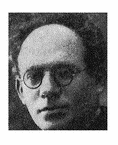
Sudarski, Mendl
December 14, 1885–December 30, 1951
He was born in the town of Vishtinets (Vištytis), Lithuania. When he was still a child, his parents moved to Verzhbolove (Verzhbelov)—at the border between Russia and Germany. His father was a brush-maker, later a manufacturer in the same line of work. Mendl studied in religious elementary school and with his grandfather, Rabbi Moyshele Vishtinetser, who was the mentor of a series of important personages in the area. Later he graduated as an external (auditor) student from the Suwalk high school and studied medicine at the Universities of Leipzig (1907-1909), Freiburg (1909-1910), and Berlin (1910-1912), from which he received his medical degree. In 1913 he moved to Kiev, but soon returned to Berlin and specialized in ophthalmology.
With the outbreak of WWI in 1914, as a Russian citizen he was interned in Berlin, and later he was sent to Sweden and from there returned to Russia, where he was mobilized and served for four years in a military hospital at the rank of lieutenant-colonel.
In 1918, after the Bolshevik Revolution, he went to Nizhny-Novgorod where the Bolsheviks drafted him and appointed him as head doctor in the eleventh artillery division.
He left Russia in 1921 and settled in Kovno, Lithuania, where he practiced medicine and was very active in Jewish cultural associations and political life. He took a leading role there in the establishment and the work of the Jewish Folkspartey (People’s Party), the Jewish Education Association, OZE (Obschestvo Zdravookhraneniia Evreev—Society for the Protection of the Health of the Jewish Population), ORT (Association for the Promotion of Skilled Trades), HIAS (Hebrew Immigrant Aid Society), YIVO,
the Algemeyne Entsiklopedye (General Encyclopedia) associated with Sh. Dubnov,
the commercial high school in Yiddish, the historical ethnographic society, the Yiddish theatrical studio, and the Jewish sports society, among other such groups. He was standing chairman of the Education Association.
In 1930 he took an active part in founding in Kovno the daily newspaper
Folksblat (People’s Newspaper), which from 1935 he co-edited with L. Kapilovitsh.
At the same time he published medical articles, as well as translations in
Folks-Gezunt (Popular Health) in Vilna,
Literarishe Bleter (Literary Newspaper) in Warsaw,
and elsewhere.
That same year his fiftieth birthday was celebrated in Lithuania. In 1937 he immigrated to the United States and settled in New York. He practiced as an eye doctor and contributed to the founding of the Federation of Lithuanian Jewry (he was initially its chairman and later its vice-president).
Over the years 1943-1947, he edited the journal
Der Litvisher Id (The Lithuanian Jew), organ of the Federation.
From 1945 until late 1951, he published in
Tog (Day) in New York
articles on medical matters and contributed as well to the New York journals:
Afn Shvel (At the Threshold),
Di Tsukunft (The Future), and
Di Feder (The Pen),
among others.
His name is bound up with the publication of the massive anthology
Lite (Lithuania), vol. 1, edited by him, Urye Katsenelenbogen, and Y. Kisin (New York: Cultural Association of Lithuanian Jews, 1951), 2007 pp. + 8 pp.
He died in New York.
“Neither a Jewish community matter,” noted B. Shefner, “nor was it a phenomenon in the field of Yiddish literature, Yiddish theater, or Yiddish art in general, which would have made him known.... There was no partition between Sudarski’s work as a doctor and his work as a writer, as a community leader, as a community intercessor, and as a patron…. He was a mixture of fantasy, enthusiasm, and naïveté.”
Sources: N. Y. Gotlib, in Keneder Adler (Montreal) (February 27, 1945; December 28, 1945); Y. Gar, in Landsberger Lager-Tsaytung (Landsberg) (February 22, 1946); G. Aronson, in Der Veker (New York) (November 15, 1951); Y. Libman, in Nyu Yorker Vokhnblat (New York) 426 (1951); M. Ladski, in Keneder Adler (January 1, 1952; January 14, 1962); Y. Y. Sigal, in Keneder Adler (January 14, 1952); D. Ben Yisroel, in Letste Nayes (Tel Aviv) (February 1, 1952; March 14, 1952); Dr. A. Mukdoni, In Varshe un in lodzh (In Warsaw and in Lodz), vol. 1 (Buenos Aires, 1955), p. 295; B. Shefner, in Forverts (New York) (January 2, 1962).