
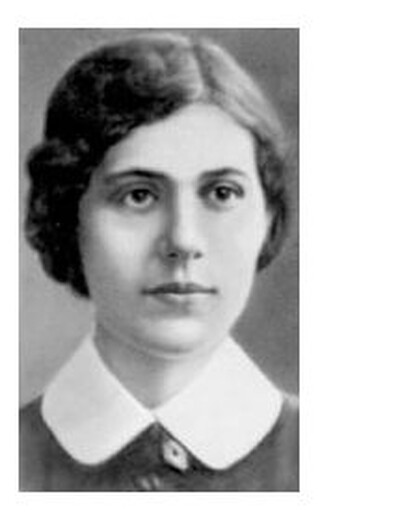
Simkhovitsh, Roze
1890-late 1941
She was born in Slutsk, Minsk district, Byelorussia. Her father, Shmuel Slutsker, was one of the greatest scholars in Lithuania, as well as a prominent follower of the Jewish Enlightenment, who was knowledgeable of literature and wrote works on Jewish law and articles in Russian-language journals. In 1894 he was a member of rabbinical commission in St. Petersburg and was invited to assume the rabbinical chair in Vienna as well as in Warsaw, but he did not wish to make the Torah a “shovel to dig with” (from which to earn a living). Her brother was the well-known Hebraist and historian Dr. Y. N. Simḥoni (1884-1926). In 1896, after her father’s death, she and her family moved to Minsk, where she entered the socialist movement at a young age and was arrested at age sixteen; she was freed quickly on condition that she go abroad.
She studied at the Jean-Jacques Rousseau Institute of Pedagogy in Geneva, while at the same time taking courses in the philosophy department at the University of Geneva. During WWI she was living in Vienna, where she worked among Jewish refugee children.
In 1919 she moved to Vilna where she was at first the manager of the Frebel course—of the Central Jewish Education Committee, OZE (Obschestvo Zdravookhraneniia Evreev—Society for the Protection of the Health of the Jewish Populatio), and Yekopo (Yekoyekopoyekopo, Yevreyskiy Komitet Pomoshchi Zhertvam Voyny—Jewish Relief Committee for War Victims). In 1921 she took over the leadership from then then created Jewish teachers’ seminary in Vilna, played a prominent role in the Yiddish school movement generally, gave reports on pedagogical and historical topics at the Vilna People’s Auditorium, and actively participated in a variety of conferences and at the first meeting of secular Jewish schools in Warsaw (1921), at which she—together with A. Golomb, Kh. Sh. Kazdan, Zalmen Reyzen, and others—were among the leaders and speakers of the independent school faction.
She was co-editor of the pedagogical monthly
Di Naye Shul (The New School) in 1921, in which she published her essays,
“Yan Amos Komenski” (Jan Amos Komenski / John Amos Comenius),
“Definitsyes fun Zakhn bay Kinder” (Definitions of Things for Children), and
“Gedanken vegn di Oyfgabn fun Undzer Kinder-Gortn” (Thoughts on the Publications of Our Kindergarten),
among others;
she also was in charge of the section
“Fun daytshe pedagogishe zhurnaln” (From German pedagogical journals).
She was also co-editor of the adult journal
Shul un Heym (School and Home).
In 1923 she had to leave Vilna because of an issue of nationality. For a time she lived in Vienna, later moving to Berlin. She took part in the pedagogical section of YIVO. When she learned of an opportunity to return to Poland, she settled in Warsaw and took charge of the division of pedagogy and psychology of Tsisho (Central Jewish School Organization). At an international pedagogical congress (under Tsisho’s mantle) in Paris in 1937, she presented a report on the new Yiddish school, which elicited enthusiasm among the delegates. At that time, she was also active in organizing the Jewish pavilion at the World’s Fair in Paris.
At the time of the Nazi occupation of Poland, she was confined in the Warsaw Ghetto, where she contributed to illegal school work, and she was the leader of the teachers’ seminary and active in Jewish social self-help. She died of typhus in the Warsaw Ghetto. In
Lerer Yizker Bukh (Remembrance Volume for Teachers) (New York, 1954), there are several responses from Simkhovitsh’s female students about her.
As Sh. Sapir-Kats put it: “This was a beautiful, pure, religious soul, modest and august in her modesty, with profound intelligence, with a fine heart and with the talent to appreciate people…. Only certain individuals knew that she deeply religious. One could see her at High Holiday time in the women’s synagogue with a holiday prayer book in her hands and her face irradiated from the sanctity of prayer. She was not bashful about praying like all the Jewish wives. Pure souls have nothing to be ashamed of.”
And, Feyge Barakin-Melamdovitsh noted: “I met Comrade Simkhovitsh the first time in 1921, when I arrived as a pupil at the Vilna Jewish teachers’ seminary. I noticed a slender, young woman, with an oblong face, a proud head, with short cut hair, and a pair of flaming, large, wise eyes. I have never once in this life forgotten those eyes…. Each time when I would enter her room, my heart beat with a special impetuousness. It was not fear. It was the sense of reverence, the feeling of solemnity that you experienced every time when you met eye to eye with Roza Simkhovits.”
Sources: Zalmen Reyzen, Leksikon, vol. 2; N. Mayzil, in Di Tsukunft (New York) (October 1935); Ts. Leder, in Poylishe Yidn (Polish Jews), yearbook (New York, 1942); D. Tsharni (Daniel Charney), in Kultur un Dertsiung (New York) (April 1, 1942); Unzer Tsayt (New York) (April 1942); Kh. Z. Kazdan, in Di Tsukunft (August 1943); Feyge Barakin-Melamdovitsh, in Unzer Tsayt (November 1944); Shloyme Mendelson, zayn Lebn un Shafn (Shloyme Mendelson, his Life and Work) (New York, 1949), pp. 387-88; Lerer Yizker Bukh (Remembrance Volume for Teachers) (New York, 1954), pp. 271-76; Khayim Leyb Fuks, in Fun Noentn Over (New York) 3 (1957), p. 260; A. Golomb, Fuftsik Yor Geshikhte fun Yidisher Dertsiung (Fifty Years of History of Yiddish Education) (Mexico City, 1957), pp. 146ff; Pinkas Slutsk uvenoteha (Records of Slutsk and its Children) (New York, 1960), p. 390; M. Vaykhert, Yidishe Aleynhilf (Jewish Self-Help) (Tel Aviv, 1962); R. Mahler, in Di Goldene Keyt (Tel Aviv) 46 (1963), p. 27.