

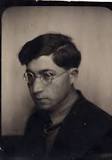
Shtrigler, Mortkhe
September 19, 1921–May 10, 1998
An author of essays, stories, and poetry, he was born in Zamość, Poland. He attended religious elementary school and yeshivas. He survived the Warsaw Ghetto and numerous hiding spots in Poland and Germany during WWII. Over the years 1945-1952, he lived in Paris, and from 1953 he was living in New York. He began writing early in life and was also writing while in camps. En route to Buchenwald, all of his writings were lost.
He published poetry, stories, and essays on issues in Judaism and articles about Zionism, Israel, and the Holocaust in: Kiem (Existence), Getseltn (Tents), Opatoshu-Leyvik Zamlbikher (Opatoshu-Leivick Collections), Morgn-Zhurnal (Morning Journal), and an especially large number in the daily newspaper he edited, Unzer Vort (Our Word) in Paris (1946-1951, the first year with Mark Dvorzhetski), as well as in Idisher Kemfer (Jewish Fighter) in New York (from 1953) and Forverts (Forward) also in New York, in which he frequently placed work from 1953 and was a regular contributor from 1968. He also published in Hebrew periodicals such as: Maḥberot (Notebooks), Hadoar (The Mail), Beterem (Before), and Moznaim (Scales).
His work appeared in: Shimshon Meltser, Al naharot, tisha maḥazore shira misifrut yidish (By the Rivers, Nine Cycles of Poetry from Yiddish Literature) (Jerusalem, 1956); and Hermann Hakel, Jiddische Geschichten aus aller Welt (Tübingen-Basel, 1967).
He penned a long series of essays on Jewish religious-philosophical issues, stories, and novels.
His died in New York.
Among Shtrigler’s longer writings:
“Shayles-Tshuves Vi a Moker fun Yidisher Geshikhte” (Responsa as a Source of Jewish History), in Forverts;
“Al hatanakh hasheni haḥazali” (On the Second Tanakh by the Sages of the Talmud), in Moznaim (1953/1954); and
in Idisher Kemfer:
“Tsvishn Harts un Tat” (Between Heart and Deed), (September 20, 1968);
“Meshiekhs Eyzl” (The Messiah’s Donkey) (September 8, 1972);
“Fun Onheyb biz Onheyb” (From Beginning to Beginning) (September 21, 1973);
“Tif in Undz Shtekt der Novi” (The Prophet Is Deep Inside Us) (1979); and many more.
Unfinished novels:
“Farshverer” (The Plotter), serialized in Idisher Kemfer (1964-1965); and
“Yeshiva baa leira” (A Yeshiva Comes to Town), in Hadoar.
In book form:
Tsu Aykh Shvester un Brider Bafrayte, Nokhmilkhome-Problemen fun Yidishn Folk (To You, Sisters and Brothers, Liberated, Postwar Issues for the Jewish People) (New York: Zamoshtsher Brentsh 375, Workmen’s Circle, 1945), 31 pp.;
In a Fremdn Dor, Lider un Poemen (In an Alien Generation, Poetry) (Paris: Yidisher folks-farband, 1947), 254 pp.;
Maidanek (Majdanek) (Buenos Aires: Central Association of Polish Jews in Argentina, 1947), 248 pp.;
In di Frabrikn fun Toyt (In the Factories of Death) (Buenos Aires: Central Association of Polish Jews in Argentina, 1948), 429 pp.;
Di Ershte Libe fun Kopl Matsh, Roman (The First Love of Kopl Matsh, a Novel) (Paris: Yidisher Folks-Farband, 1948), 171 pp., the second part never appeared in print;
Verk Tse (Work “C”) (Buenos Aires: Central Association of Polish Jews in Argentina, 1950), 2 vols.;
Goyroles (Destinies) (Buenos Aires: Central Association of Polish Jews in Argentina, 1952), 2 vols.;
Georemt Mitn Vint, Historisher Roman fun Yidishn Lebn in Poyln (Arm in Arm with the Wind, a Historical Novel of Jewish Life in Poland) (Buenos Aires: Central Association of Polish Jews in Argentina, 1955), 2 vols.;
Shmuesn mit der Tsayt, Intime Kapitlen fun a Yidishn Khezhbn (Conversations with the Time, Intimate Chapters of a Jewish Summing Up) (Buenos Aires: Kiem, 1959, 1961), 2 vols., 270 pp. and 333 pp.;
Inzlen af der Erd, Noveln (Islands on the Earth, novellas) (New York: Idisher Kemfer, 1957), 275 pp.
He translated Zalman Shazar’s Shtern Fartog, Zikhroynes, Dertseylungen (Dawn Stars, Memoirs, Stories [original: Kokve boker]) (Buenos Aires: Central Association of Polish Jews in Argentina, 1952), 270 pp., second edition (1966).
His pen names include: A. Kora, M. Kalikshteyn, A. Ben-Ami, M. Ragil, Z. Kamay, M. Dober, and A. K.
“Shtrigler doesn’t wish to recount only valiant tales,” wrote Shiye Rapoport. “He doesn’t wish to recount only particular facts to high heaven, [but] the internal suffering, the profound psychological struggle, and such human pain of a generation in dreadful misery.”
“M. Shtrigler is many sided in literary genres,” noted Meylekh Ravitsh, “for communicating his feelings and thoughts to his reader in books and periodicals.”
“M. Shtrigler,” commented Froim Oyerbakh, “strides broadly across Jewish history, penetrating its trends and bringing profound Jewish wisdom to us.”
In the words of Yitskhok Yanasovitsh: “Both as the author of fiction and as a journalist and essayist, he belongs to a small group of writers among us who guide the reader somewhere…. He nurtures in depth where it often dark, but he shows the darkness to illuminate with flash and acumen…. He discerns things that no one before him has discerned.”
Sources: H. Leivick, in Tsukunft (New York) 8 (1945); H. Leivick, Eseyen un Redes (Essays and Speeches) (New York, 1963), pp. 287-91; Shiye Rapoport, Ershter Shnit Nokhn Shturem (First Harvest After the Storm) (Melbourne: Friends of Yiddish Literature, 1948), pp. 353-65; Rapoport, Zoymen in Vint (Seeds in the Wind) (Buenos Aires, 1961), pp. 478-88; A. Mukdoni, in Tsukunft 9 (1955); Meylekh Ravitsh, in Tsukunft 9 (1957); Ezriel Naks, in Tsukunft 7 (1960); Froim Oyerbakh, in Idisher Kemfer (New York) (July 13, 1962); Yankev Glatshteyn, Mit Mayne Fartog-Bikher (With My Daybreak Books) (Tel Aviv, 1963), pp. 555-69; Yitskhok Yanasovitsh, Penemer un Nemen (Faces and Names), vol. 2.: Yidishe Prozayikers Nokh der Tsveyter Velt-Milkhome (Yiddish Prose Writers after WWII) (Buenos Aires, 1977), pp. 322-26; Yeshurin archive, YIVO (New York).