
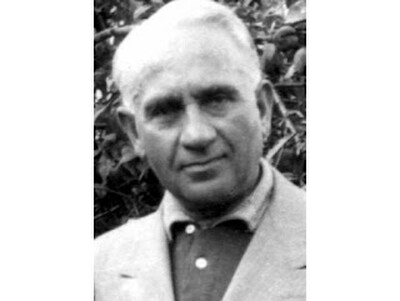
Shindler, Leyzer
April 28, 1892–September 22, 1957
He was a religious poet, born in Titshin (Tyczyn), Galicia. At age three he started attending religious elementary school, and at nine he studied for a term in the municipal school. Around 1901 he left with his parents for Munich, studied at an electro-technical institute and took up self-education. There he founded the first Yiddishist association, Bene Yehuda.
In WWI he fell into Russian captivity as an Austrian soldier. He worked for two years in agriculture for the Tatars and went on to live in Saratov, later leaving for the Jewish converts in the Astrakhan and Tsaritsyn (later, Stalingrad; now, Volgograd) region and agitated for the Jewish faith.
In 1919 he returned to Munich. Dr. Nosn Birnboym (Nathan Birnbaum) had a major influence on him, and Shindler became one of his closest disciples. He drew close to the Beys-Yankev schools and created a textbook for them.
In 1938 he emigrated to the United States, two years later becoming a farmer near Lakewood, New Jersey, and he died in Lakewood.
He wrote poetry, stories, legends, and did translations. He debuted in print with poetry and essays in: Yudish-Religyezer Arbayter (Jewish Religious Worker) in Cracow. He contributed work to: Beys-Yankev Zhurnal (Beys Yankev Journal), Kindergortn (Kindergarten), Frishinke Blimelekh (Fresh Flowers), Dos Yudishe Togblat (The Jewish Daily Newspaper), and Ortodoksishe Yugend-Bleter (Orthodox Youth Newspaper) in Warsaw; Vokhentsaytung (Weekly Newspaper) in London; Grininke Beymelekh (Little Green Trees) and Khaver (Friend) in Vilna; Tshernovitser Bleter (Czernowitz Newspaper); Idisher Kuryer (Jewish Courier) in Chicago; Argentiner Beymelekh (Little Argentinian Trees) in Buenos Aires; Unzer Leben (Our Life) in Leipzig; Nyu-Yorker Vokhnblat (New York Weekly Newspaper) (1942); and Di Feder (The Pen) in New York (1943); among others.
His work also appeared in: Shmuel Rozhanski, Yidish in Lid, Antologye (Yiddish in Poetry, Anthology) (Buenos Aires, 1967); and Dos Kind in Yidisher Poezye (The Child in Yiddish Poetry) (Buenos Aires, 1971).
His own works include:
Derner (Thorns), poetry (Berlin: Las, 1912), under the pen name Ben-Gole, in roman lettering;
Fun Step un Yishev, Gidikhtn (From the Steppe and Community, Poems) (Leipzig: A. Pries, 1922), 71 pp.;
A Kval Zikh Zingt, Shirim (A Fountain Sings, Poems) (Antwerp: Sh. Hertsog, 1924), 61 pp.;
Shirim un Iberzetsungen (Poems and Translations) (Berlin: L. Abramson, 1927), 64 pp.;
Lider (Poetry) (Vilna: Grininke Beymelekh, 1929), 61 pp.;
Vos Felker Dertseyln, Mayselekh (What People Recount, Stories) (Vilna: Grininke Beymelekh, 1936), 47 pp.;
D”r Nosn Birnboym un zayn Milkhome far Alie (Dr. Nathan Birnbaum and his War on Behalf of Aliya) (Lodz: Beys-Yankev, 1930), 12 pp.;
Fremde Mayselekh far Yidishe Kinder (Foreign Stories for Jewish Children) (Vilna: Grininke Beymelekh, 1930), 47 pp.;
Di Yidishe Neshome (The Jewish Soul) (Lodz: Beys-Yankev, 1931), 111 pp.;
Unzer Gezang (Our Song) (Lodz: Beys-Yankev, 1931);
Vos di Velt Dertseyln, Mayselekh fun Umetum (What the World Recounts, Stories from Everywhere) (Vilna: Grininke Beymelekh, 1936), 47 pp.;
Vos in Vald iz Geshen, Mayselekh fun Nont un Vayt (What Happened in the Forest, Stories from Near and Far) (Vilna: Grininke Beymelekh, 1936), 47 pp.;
Yidishe Legendes (Jewish Legends) (Vilna: Grininke Beymelekh, 1936), 48 pp.;
Iber Lender un Yamen, Mayselekh fun Gorer Velt (Over Lands and Seas, Stories from the Whole World) (Vilna: Grininke Beymelekh, 1937), 47 pp.;
In Shtile Farnakhtn, Mayselekh fun Mizrekh un Mayrev (On Quiet Evenings, Stories from East and West) (Vilna: Grininke Beymelekh, 1937), 48 pp.;
Der Mizrekh Shmeykhlt, Persishe, Khinezishe, Indishe un Andere Mayselekh (The East Smiles: Persian, Chinese, Indian, and Other Stories) (Vilna: Grininke Beymelekh, 1937), 47 pp.;
Milgroym, Maysehlekh fun Farsheydene Felḳer (Pomegranate, Stories of Various Peoples) (Vilna: Grininke Beymelekh, 1937), 47 pp.;
Mayselekh fun arbe pines haoylem (Stories from Four Corners of the World) (Vilna: Grininke Beymelekh, 1937), 47 pp.;
Tsvishn Khidekl un Ganges, Oryentalishe Mayselekh (Between the Tigris and the Ganges, Oriental Stories) (Vilna: Grininke Beymelekh, 1937), 47 pp.;
Tsvishn Tog un Nakht, Mayselekh fun Farsheydene Felker un Shvotim (Between Day and Night, Stories from Various Peoples and Tribes) (Vilna: Grininke Beymelekh, 1937), 44 pp.;
Af Zunike Pleyner, Mayselekh fun Umetum (On Sunny Plains, Stories from Everywhere) (Vilna: Grininke Beymelekh, 1937), 47 pp.;
Fun der Eybiker Shefe, Mayselekh fun Farshidene Felker (From Perpetual Abundance, Stories of Various Peoples) (Vilna: Grininke Beymelekh, 1938), 47 pp.;
Yidish un Khsidish, Lider (Yiddish and Hassidic, Poems) (New York: Shulzinger Brider, 1950), 243 pp.
He edited (with Mendl Naygreshl): Kleyne Antologye fun der Yidisher Lirik in Galitsye, 1897-1935 (A Short Anthology of the Yiddish Lyric in Galicia, 1897-1935) (Vienna: A. B. Tserata, 1936), 47 pp.
His pen names include: Ben-Gole, Eshel, L. Rednish, and Sadye Abramson.
“Eliezer Shindler is a pious Jew…,” wrote Arn Leyeles, and “his piety can be dressed up in poetry…. For his mood he has found words that I embrace both as experience and as poetic expression.”
“The folk poet (one might say: the Yiddish troubadour),” noted Yankev Glatshteyn, “…was deeply religious and his enthusiastic poetry primarily found redress in the devout mouths of the pupils in Aguda schools…. In the American solitude, [he]…often got lost in the folkish tone…. With his death, one more string of the popular Jewish fiddle was ripped out, for although people hardly heard it, it is now gone.”
Sources: Zalmen Reyzen, Leksikon, vol. 4; Nosn Birnboym, in Der Aufstieg (Berlin) (1930); Arn Leyeles, in Tog (New York) (June 24, 1950); Meyer Shvartsman, in Keneder Adler (Montreal) (December 3, 1950); Mendl Naygreshl, in Fun Noentn Over (New York) 1 (1955), pp. 352-53; Yankev Glatshteyn, Idisher Kemfer (New York) (February 14, 1958); Yeshurin archive, YIVO (New York).