
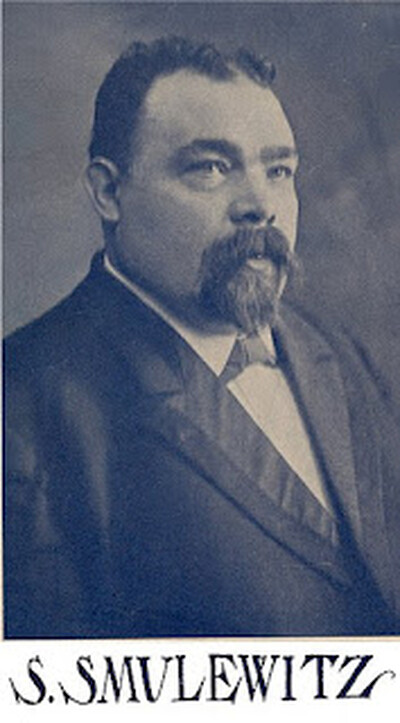
Shmulevitsh, Shloyme
April 13, 1868–January 1, 1943
He was a folk poet, born in Pinsk. His mother died while in labor with him and his father, a cantor, when he was twelve. He then became a tailor’s apprentice and a choirboy to cantors, and he traveled about with a theatrical troupe.
He wrote poetry, set them to accompanying melodies, and sang them in various and sundry cities. In 1884 he attended Rameyle’s circle in Vilna, later settling in Minsk.
He became a wedding entertainer, wrote poems with music for wedding entertainers, and also composed tunes for numerous poems in the plays of Shomer (pseud. Nokhum-Meyer Shaykevitsh).
In 1891 he made his way to the United States, where he appeared in concert with his own songs, together with his only daughter Dorothy. Shmulevitsh wrote about 500 poems with melodies, ten one-act operettas for the Yiddish theater and Yiddish vaudeville houses, and musical comedies, such as: Der yoysher (Justice), Baym Bezdn shel Mayle (At the Heavenly Court), Fraytik af Hester Strit (Friday on Hester Street), Pastekh un Printsesin (Shepherd and Princess), and Fun Glik Tsum Shtrik (From Happiness to the Rope).
A series of his songs became popular as folksongs and were sung at concerts and by the people in many countries, such as “Dos Talesl” (The Dear Prayer Shawl), “A Brivele der Mamen” (A Letter to Mother), “Khave” (Eve), “Vayiten Lekho” (And He Gave Him), “Dos Blumen-Krentsele” (The Little Flower Garland), “Di Seyder-Nakht” (The Night of the Passover Seder), “Elis Ayland” (Ellis Island), and “Al Tashlikheynu” (Forsake Us Not), among others.
“Khave” was so popular that Feodor Chaliapin included it in his repertoire. Some of his poems appeared in: Morris Basin, 500 Yor Yidishe Poezye (500 Years of Yiddish Poetry) (New York, 1922); Yoyel Entin, Yidishe Poetn, Hantbukh fun Yidisher Dikhtung (Yiddish Poets, a Handbook of Yiddish Poetry) (New York: Jewish National Labor Alliance and Labor Zionist Party, 1927); Nakhmen Mayzil, Amerike in Yidishn Vort (America in the Yiddish Word) (New York, 1955); and Shmuel Rozhanski, Di Froy in der Yidisher Poezye (Women in Yiddish Poetry) (Buenos Aires, 1966); and Rozhanski, Nord-Amerikanish, Antologye (North American, Anthology) (Buenos Aires: YIVO in Argentina, 1977).
In notebook and book form:
Tsehn naye yudishe folks-lieder (Ten new Yiddish folksongs), “written with harmony and musical accompaniment” (Vilna: Rozenkrants-Shriftzetster, 1891), 64 pp.;
Der theater zinger (The theater singer), “ten popular songs” (New York, 1905-1909), five notebooks;
Lieder (Songs) (New York, 1913), 186 pp., later edition (1919); Poezi un lieder (Poetry and songs) (New York, 1916), 195 pp.;
Originele retenishn (Original riddle) (New York, 1918) (a second volume in Yiddish and English, 1938), 40 pp.;
Odem horishn, a dramatishe poeme (Adam, the first man, a dramatic poem) (New York, 1936), 32 pp.;
Fun unzer folks-kval, legendes un baladen (From our people’s source, legends and ballads) (Brooklyn, 1940), 64 pp.
He often published single poems, such as: A Brivele der Mamen, In der Frayer Republik (In the Free Republic), or Zay Mayn Liedel Mir a Hamer (Let My Poem Be a Hammer for Me) (New York, 1907), each 4 pp., and A Hayntigs Meydel (A Girl Today) (New York, 1932), 3 pp.—and a large number of songs for the piano. Shmulevitsh’s songs and fables were from time to time published in American Yiddish newspapers.
He died in New York.
“One of the last Mohicans,” wrote Zalmen Reyzen, “of the wedding entertainer’s art,…he excelled in his authentic folk tone. His simple, uncontrived songs, permeated with a profound compassion for the sufferings of the people, often also an ethnic tenor,…for many years nourished the repertoire of Jewish popular and street singers in America, England, and at one time in Poland and Russia.”

One should not confuse Shloyme Shmulevitsh with SH. H. SHMULEVITS, considered the author of Sefer niflaot haniflaot (The Book of Wonders of Wonders), “a rare historical description” (Warsaw: Y. Breyzblat, 1912), 37 pp. There is also a certain SHMUEL SHMULEVITS, the author of the storybook Di Raykhe Printsesin (The Wealthy Princess).
Sources: Zalmen Reyzen, Leksikon, vol. 4; Zalmen Zilbertsvayg, Leksikon fun Yidishn Teater (Lexicon of the Yiddish Theater), vol. 6 (Mexico City, 1969); Elye (Elias) Shulman, Geshikhte fun der Yidisher Literatur in Amerike 1870-1900 (A History of Yiddish Literature in the United States, 1870-1900) (New York: Biderman, 1943), pp. 151-55; Yisroel-Ber Beylin, in Morgn Frayhayt (New York) (June 22, 1958); Ber Grin, Fun Dor tsu Dor (From Generation to Generation) (New York, 1971), pp. 188-91; Sh. Tenenboym, in Tsukunft (new York) (November 1972); YIVO archives (New York).