
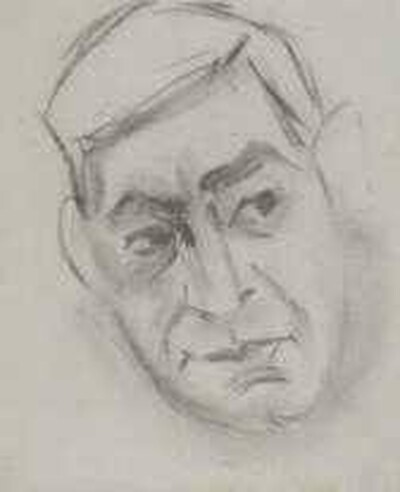
Kaganovski, Froim
1893–October 17, 1958
He was born in Warsaw, having descended from a well-to-do family. He exhibited painting abilities and for a short time attended a drawing school.
In 1914, when the German army was approaching Warsaw, he and his family were evacuated to Odessa. There he became acquainted with the local Yiddish and Russian writers. In 1921 he returned to Warsaw.
In 1939 he again fled, initially to Bialystok and later to deep into Russia. He spent the first few years after the war in Warsaw. In 1949 he made his way to Paris.
He made his literary debut with the story “Baynakht in Dorf” (The Village at Night) in Noyekh Pryłucki’s Di Teater-Velt (The Theater World) in 1909. Y. L. Perets befriended him closely and published his novella “Der Alter Moyel” (The Old Circumcizer) in the anthology Yudish (Yiddish) in 1909. From that point in time, he became a professional writer.
He published novellas, sketches, essays, and features in: Di Yudishe Velt (The Jewish World), Moment (Moment), Vilner Tog (Vilna Day), Fraynd (Friend), Dos Naye Land (The New Country), Haynt (Today), Tsukunft (Future), Riga’s Frimorgn (Morning), Ilustrirte Vokh (Illustrated Week), Lipe Kestin’s Naye Himlen (New Skies), Fakel (Torch) in Pyotrkow (1911), Lebens-Klangen (Sounds of Life) in Warsaw (1911/1912), Frihling Shtromen (Currents of Spring) in Warsaw (1912), A. Farba’s Likhtlekh (Candles) in Warsaw (1914), Vokhnshrift far Literatur (Weekly Writing for Literature), and Yidishe Shriftn (Yiddish Writings) in Lodz-Warsaw.
He was a regular contributor to Warsaw’s Unzer Ekspres (Our Express), in which he published a long story in weekly installments, entitled “Fun’m Stavski-Gesel” (From Stavski Alley)—and later to Parizer Tsaytshrift (Parisian Periodical) and Naye Prese (New Press) in Paris. Very short stories by him were republished in the Yiddish press around the world. His work was represented in: H. Hakel, Yiddische Geschichten aus aller Welt (Yiddish Stories from Around the World) (Tubingen-Basil, 1967).
He died in Paris.
His writings include:
Meydlekh, Yugend Epizodn (Girls, Youth Episodes) (Warsaw: Kultur, 1914), 54 pp.;
Tirn un Fenster (Doors and Windows) (Warsaw, 1921), 244 pp., second edition (Warsaw: Sh. Yatshkovski, 1923), third edition (B. Kletskin);
Layb un Lebn, Noveln (Body and Life [Body and Soul], Stories) (Vilna: B. Kletskin, 1928), 255 pp.;
Noveln (Stories) (Vilna: B. Kletskin, 1928), 208 pp.;
Figurn, Dertseylungen (Figures, Stories) (Warsaw: PEN Club, 1937), 320 pp.;
Alt Lebn (Old Life) (Minsk: State Publ., 1941);
Yidishe Shrayber in der Heym (Yiddish Writers at Home) (Lodz: Yidish Bukh, 1949), 72 pp.;
Shriftn (Writings) (Paris, 1951), 336 pp.;
Yidishe Shrayber in der Heym (Paris: Oyfsnay, 1956), 528 pp.;
Poylishe Yorn (Polish Years) (Warsaw: Yidish Bukh, 1956), 462 pp.;
A Shtot af der Volga (A City on the Volga) (Warsaw: Yidish Bukh, 1961), 296 pp.;
Di Tunkele Dire, Mayn Kindheyt (A Dark Apartment, My Childhood) (Tel Aviv: Hamenorah, 1965), 388 pp.
“From isolated studies, from isolated features,” wrote N, Mayzil, “…there emerges with F. Kaganovski an immense canvas, a wonderful panorama in which all of the scenes are a bit pregnant with life…. An entire environment…with its people, figures, types, old and young, poor and rich, families and social positions…that existed in Warsaw life. The shortness and austerity in describing and recounting, the elegiac doubt and the touching regret come more assuredly than in Anton Chekhov.”
“A collection of his short stories,” noted Yankev Glatshteyn, “…belongs among the most beautiful volumes of our Holocaust literature and…are documents which are not only indispensable as beautiful literature, but useful as a living record of a generation destroyed.”
Kaganovski himself wrote that his first stories were “received…by the literary critics as a new vein in Yiddish prose, whose theme was not Jewish and which expressed images of an unknown world for Jewish readers—from the world of a foreign city.”
Sources: Zalmen Reyzen, Leksikon, vol. 3; Meylekh Ravitsh, Mayn Leksikon (My Lexicon), vol. 1 (Montreal, 1945); Bikher-Velt (Vilna) (1922), p. 154; Literarishe Bleter (Warsaw) 29 (1932); Yankev Botoshanski, Portretn fun Yidishe Shrayber (Portraits of Yiddish Writers) (Warsaw, 1933), pp. 55-66; Tsukunft (New York) 5 (1939); Y. Y. Trunk, Di Yidishe Proze in Poyln in der Tekufe Tsvishn Beyde Ṿelt Milkhomes (Yiddish Prose in Poland in the Era of the Two World Wars) (Buenos Aires, 1949), pp. 150-51; Dovid Sfard, Shtudyes un Skitsn (Studies and Sketches) (Warsaw: Yidish Bukh, 1955), pp. 35-43; N. Gris, in Parizer Tsaytshrift (Paris) 12 (1956); N. Mayzil, Noente un Eygene, fun Yankev Dinezon biz Hirsh Glik (Near and One’s Own, from Yankev Dinezon to Hirsch Glick) (New York, 1957), 283-94; Zamlungen (New York) 16 (1958); Heymish (Tel Aviv) (December 1958); Yidishe Shriftn (Warsaw) 6 (1958); G. Kenig, Parizer Tsaytshrift 22 (1959); Yankev Glatshteyn, In Tokh Genumen (In Essence), vol. 1 (Buenos Aires, 1960), p. 208; Y. Hofer, Mit Yenem un Mit Zikh, Literarishe Eseyen (With Another and with Oneself, Literary Essays) (Tel Aviv: Peretz Publ., 1964), pp. 183-211; Y. Yanasovitsh, Penemer un Nemen (Faces and Names), vol. 2 (Buenos Aires-Tel Aviv, 1971), pp. 251-68; Y. Shpigl, Geshtaltn un Profiln (Figures and Profiles) (Tel Aviv, 1971), pp. 155-63; Kh. Finkelshteyn, in Haynt (Tel Aviv) (1978), p. 253.