
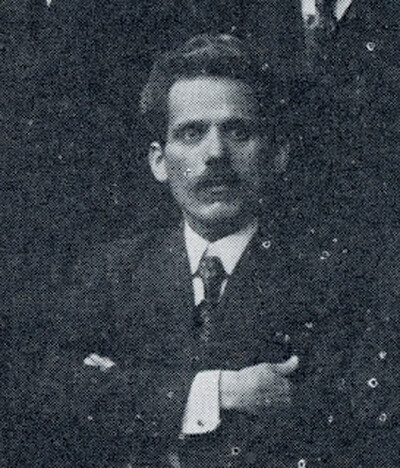
Kaplan, Peysekh
September 4, 1870–1943
He was a Hebrew and Yiddish writer, born in Stavisk, Lomzhe region, Poland. In 1883 he was brought to join his father in Horodishtsh (Gorodishche). He studied in religious elementary school and yeshivas. From 1888 he was living in Bialystok.
He turned his attention to teaching, and in 1897 he graduated from the teachers’ training course in Grodno and opened a city school in 1900. He later devoted himself entirely to journalism and editorial work. He was initially a Zionist, later switching to territorialism, and finally (in 1918) to the Folkspartey (People’s Party); and he was a councilman in the Jewish city council of Bialystok.
He did good work on behalf of Jewish music and published several songbooks in Hebrew and Yiddish. He debuted in print in 1889 in Hamelits (The Advocate) and contributed to other Hebrew periodicals as well.
He was a fierce opponent of Yiddish, calling it “safa bazuya” (a despised language), but after starting 1904 by writing for Tog (Day) and Fraynd (Friend) in St. Petersburg, he grew closer to Yiddish, and from 1914 he was tied in his literary journalistic career to it.
He published articles, feature pieces, stories, reviews, and from time to time poetry in M. Shiva’s Di Hayntige Tsayt (Contemporary Times), Dos Byalistoker Vort (The Bialystok Word) which he edited (1913-1914, initially a weekly and later a daily), and other serials in Bialystok; correspondence pieces in Haynt (Today), Moment (Moment) using the pen name Z. Vaynshteyn, and Forverts (Forward) under the pen name Tsemekh.
His most productive literary-journalistic work, though, was connected to the daily newspaper Dos Naye Lebn (The New Life), which he founded in 1919 and existed (in the early 1930s under the title Unzer Lebn [Our Life]) until the outbreak of WWII. Almost every day, he wrote for this newspaper an article, feature, fictional item, theater or film review, using pseudonyms such as: P. K., Khonen, M. Fuksman, B. Ts-n, Z. Goldshteyn, and Yedidye.
He also edited Byalistoker Vort (Bialystok Word) in 1917 (initially a weekly, later a daily) and Byalistoker Almanakh (Bialystok Almanac) (1931), and co-edited Byalistoker Leksikon (Bialystok Handbook) (1935), among other works.
Kaplan’s ghetto poems were published in Shmerke Katsherginski’s Lider fun di Getos un Lagern (Poems of the Ghettos and Concentration Camps) (New York, 1948), Moyshe Prager’s Min hametsar karati (From the Depths I Read) (Jerusalem, 1956), B. Marks’s Der Oyfshtand in Byalistoker Geto (The Resistance in the Bialystok Ghetto) (Warsaw: Jewish Historical Institute, 1950), and Hubert Witt’s Der Fiedler vom Getto: Jiddische Dichtung aus Polen (The Fiddler of the Ghetto, Yiddish Poetry from Poland) (Leipzig, 1966, 1978).
One of Kaplan’s last ghetto poems, entitled “Rivkele di Shabesdike” (Rivkele the Sabbath [girl]), was published in Folks Shtime (Voice of the People) in Warsaw (August 17, 1960).
In Yad Vashem in Jerusalem there may be found copies of his Byalistoker Yudnrat (Bialystok Jewish Council) and Geyresh Byalistok (Expulsion of Bialystok).
In book and pamphlet form:
Di Yudishe Natsyonal Biblyothek in Yerusholaim (The National Jewish Library in Jerusalem) (Odessa: Zionist kopek library, 1911/1912), 18 pp.;
Yapanishe Mayselekh (Japanese Stories) (Bialystok, 1921), 91 pp.;
Gezang-Oytser far Shul un Heym (Treasury of Songs for School and Home), 108 new Yiddish songs with notation (Kaplan’s own songs which he wrote while running a children’s home, 1914-1915) (Bialystok, 1924), 105 pp. + 64 pp.;
Byalistoker Zamelheft, Leṭoyves der Biliger un Umzister Kikh (Bialystok Anthology, on Behalf of the Inexpensive and Free Kitchen), 3 vols. (Bialystok, 1933-1938).
His translations include:
M. Mandelshtam, An Ofene Brief tsu di Rusishe Tsienistn (An Open Letter to the Russian Zionists) (Vilna: Widow and Brothers Romm, 1904/1905), 16 pp. (several printings);
Y. Zangwill, Der Teritoryalizm un Zayne Gegner (Territorialism and its Opponents) (Warsaw: Medine, 1905/1906), 32 pp.;
Lieder-Bukh, a Zamlung fun Gezangen far Khor un Solo (Songbook, a Collection of Songs for Chorus and Solo), translated from classical poems with music by Felix Mendelssohn, Franz Schubert, Robert Schumann, and others, with seven original pieces (Warsaw: Bikher-far-Ale, 1912), 160 pp., second edition (Warsaw, 1914);
Krilovs mesholim (Krykov’s Fables) (Bialystok: Kultur-Lige, 1918), 78 pp., full edition (Bialystok: A. Albek, 1921-1922), three parts in 2 vols., 146 pp.;
V. Korolenko, On a Loshn (Without a Language [original: Bez yazyka]) (Bialystok: Dos bukh, 1921), 202 pp.;
Heinrich Mann, Di Orime, Roman (The Poor [original: Die Armen: Roman] (Bialystok: A. Albek, 1921), 258 pp.;
Dmitry Mamin-Sibiryak, Khaneles Mayselakh (Hannah’s Tales), under the pen name Yedidye (Bialystok: Kultur-Lige, 1921), two parts in one volume;
Rudyard Kipling, Der Keml un zayn Horb (The Camel and his Hump [original: “How the Camel Got His Hump”]) (Bialystok: Dos bukh, 1921), 15 pp.;
Der Alter Kongur (The Old Kangaroo [original: “The Sing-Song of Old Man Kangaroo”]) (Bialystok: Dos bukh, 1921), 16 pp.;
Shir hashirim (Song of Songs) (Bialystok: A. Albek, 1922), 27 pp.;
Rambam in Yidish, Geklibene Shriftn (Maimonides in Yiddish, Selected Writings) (Bialystok: Unzer prese, 1935), 160 pp.
Kaplan also translated plays, opera, and operettas which were staged 1912-1914 in Yiddish theaters:
Shoshane di Tsnue (Shoshana the Chaste Woman), Khave (Eve), Tsigayner-Libe (Romani Love), Puptshik (Little Guy), and Meydl-Mark (Girl Market).
Two of them were published:
Pietro Mascagni, Di Dorfishe Ere (Village Honor [original: Cavalleria Rusticana (Rustic Chivalry)]) (Warsaw: Bikher-far-Ale, 1912/1913), 22 pp.; Ruggero Leoncavallo, Di Payatsn (The Clowns [original: Pagliacci]) (Warsaw: Bikher-far-Ale, 1912), 35 pp.
In his first period, Kaplan not only contributed to many Hebrew-language periodicals, but he also published a series of books in Hebrew, largely translations, and he also translated from Hebrew into Yiddish, such as:
Dovid Pinski, Gliksfargesene (Happily forgotten), 16 pp.;
Osip Dimov, Shma yisroel (Hear, O Israel), 50 pp.;
M. Ornshteyn, Dos eybike lid (The eternal song)
— all: Bialystok: Habima, 1913.
He died in the Bialystok ghetto.
Sources: Zalmen Reyzen, Leksikon, vol. 3; Getzel Kressel, Leksikon hasifrut haivrit (Lexicon of Hebrew Literature), vol. 2 (Merḥavya, 1967); Literarishe Bleter (Warsaw) 23 (1924); Unzer Lebn (Bialystok) (October 14, 1938); Zusman Segalovitsh, Tlomatske 13, fun Farbrente Nekhtn (13 Tłomackie St., of Zealous Nights) (Buenos Aires: Central Association of Polish Jews in Argentina, 1946), p. 187; R. Rayzner, Umkum fun Byalistoker Geto (The Destruction of the Bialystok Ghetto) (Melbourne, 1948), p. 155; Avrom Shmuel Hershberg, Pinkes Byalistok (Records of Bialystok), vols. 1-2 (New York, 1949-1950), see index; B. Marks, Der Oyfshtand in Byalistoker Geto (The Resistance in the Bialystok Ghetto) (Warsaw: Jewish Historical Institute, 1950), pp. 143-44; A. Zak, In Onheyb fun a Friling, Kapitlekh Zikhroynes (At the Start of Spring, Chapters of Memoirs) (Buenos Aires: Farband fun Poylishe Yidn, 1962), pp. 206-9; E. R. Malachi, in Al admat besarabya (On Bessarabian Soil) (Tel Aviv, 1962/1963), pp. 16-21; Itonut yehudit shehayta (Jewish Press That Was) (Tel Aviv, 1973), see index; YIVO archives (New York).
The author and singer (kupletist) of Puptshik (Little guy) is Konopov/Konopof.
Puptshik is a couplet and it gave the name to the collection of 10 trolls.
פופטשיק : קופלעטן /קאנאפאװ; אידיש פון פסח קאפלאן
ביאליסטאק
1913.- 16 pp.
Puptshik :kupletn /Konopov; yidish fun Peysekh Kaplan
PEYSEKH KAPLAN did poetic adaptation in Yiddish stories from TNKh, lirics and biblical epic. At first it was planned to publish 5 volumes but finally only 3 volumes were issued.
ביבלישע געזאנגען : פינף ביכער
פסח קאפלאן
ביאליסטאק : קאמיטעט ארויסצוגעבן די װערק פון פסח קאפלאן
1938
Biblishe gezangen :(finf bikher)
Byalistok : Bialistoker komitet oystsugebn di verk fun Peysekh Kaplan
Volume 1.
ליריק /הקדמה פון פסח קאפלאן.ערשטער בוך
280, XVI pp.
Lirik /hakdamah fun Peysekh Kaplan. ershter bukh
Volume 2.
עפאס /הקדמה פון פסח קאפלאן. צװײטער בוך
244, IV pp.
Epos /hakdamah fun Peysekh Kaplan. tsveyter bukh
Volume 3.
עפאס און ליריק /נאכװארט פון פסח קאפלאן. דריטער בוך
Epos un lirik /nokhvort fun Peysekh Kaplan. driter bukh