Leksikon fun der Nayer Yidisher Literatur
לעקסיקאָן פֿון דער נײַער ייִדישער ליטעראַטור

Browse All People
By Subjects
By Volume:

search tips
✕
≡

How to Build Your Search:

A. In the below “Advanced Search,” use the drop down parameters under "Scope" - ALL words, ANY words, or EXACT word/phrase. Build the parameters row by row.


OR


B. To define your search using the basic one-line search, in the above textbox:

  • Use a plus to REQUIRE the word:
    +music +theory << must contain the words music and the word theory
  • Use quotes for a phrase:
    song "music theory" << anything with song or phrase "music theory"
    or "levin" < exact match, not levine
  • Use + and quotes to require the phrase:
    +"music theory" << must include phrase
  • Use a minus to EXCLUDE:
    +music -theory << must include music, but not theory
NOTE: When searching in Yiddish letters, this Lexicon should find the word(s) with or without diacritics (e.g., אברהם vs. אַבֿרהם) -- but when searching in other systems, if you can't find it one way, try searching the other way.
⋮⋮
⋮⋮
Search:
Text
Dates
Subjects
Living People ONLY
Women ONLY
Records w/ Images ONLY
Search in:
Scope:
ALL words
ANY words
EXACT word/phrase
א אַ אָ ב בּ בֿ ג ד ה ו װ ױ ז ח ט י יִ ײ ײַ כ כּ ך ל מ ם נ ן ס ע פּ פֿ פ ף צ ץ ק ר ש שׂ תּ ת ־

click for image pop-out

Click, drag, enlarge the below information boxes. (Then click the arrow in upper right to return them to their place & size.)
Pen Names, Aliases, & Alternate Search Spellings

Meynke, K.

Kats, Meynke

Badane, Meynke

באַדאַנעס־קאץ, מענקע

Places
Birth Place
Sventsyan (Švenčionys), Lithuania
Death Place
Spring Glen, New York
Images (click an image for slideshow)
Further Info

From the author's granddaughter:

“Songs of my Grandfather” was a true Handler/Katz family project album created in 1988 as a tribute to my mother’s father, International Yiddish/English poet, Menke Katz.

My name is Shelley Ava Handler Murphy, but my Mom, Troim Katz Handler,  usually called my by my Yiddish nick-name, Sheh-sheh, after her maternal grandmother, so this is the name I chose to use on the album.

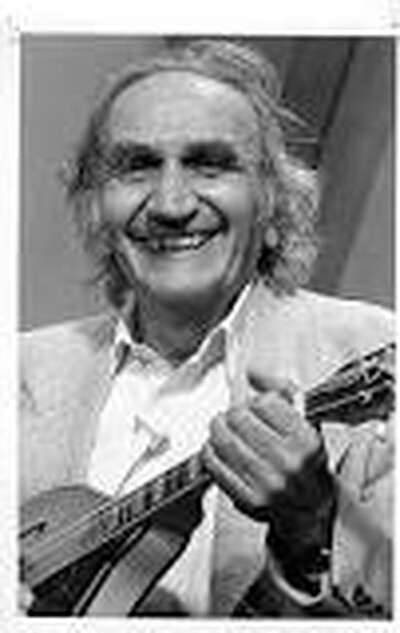
I grew up on Long Island, in NY, with my mother, my father, Frank Handler, and my sister, Claudia.  Throughout my childhood, our family regularly visited Troim’s Father, Menke, his wife, Rivke, and their son, Dovid, either at our home or theirs, first at their wonderful old house in Brooklyn, and then at their upstate NY cottage in Spring Glen.  Those visits spanned decades, always beginning with gifts, and always filled with food, stories told by Menke, l’Chaim’s, and music.  The music was provided by Menke, who accompanied himself on his mandolin, singing endless Yiddish folk songs that he recalled from his chilhood village of Mikhalishek, in Lithuania.  He had previously collected them in his book, “Yiddish songs for Oxford”, where it was used as a textbook in the Yiddish program there.  I always loved singing and chimed in as able, but many of the songs had seemingly endless Yiddish verses and vague, amorphous melodies, seemingly borne more of Menke’s joy and boundless enthusiam than actual discernible notes. 

By 1988, I was teaching, after having spent a couple of decades as a professional singer.  My sister, Claudia, and her then-partner, Joe Jedrlinic, co-owned a recording studio.  

One day, inspiration hit me over the head, and after speaking with everyone, we decided to create a family project of arranging and recording Menke’s songs for posterity.

I drove up to Spring Glen with a small Radio Shack tape recorder, and for many hours, Menke sang with his mandolin into the small, built-in condenser mike.  It was a memorable day.  When I returned home, I worked with the cassettes to select songs that I felt would lend themselves to our project, and pinned down the melodies.  Then I went to my mother for help with the lyrics.  She provided expert translations, transliterations, and Yiddish transcriptions.  I am not a Yiddish-speaker, but my Mother and Menke only spoke to each other in Yiddish, so I felt comfortable with the accent, inflections and construction.  Of course, she was both the first and final word with regard to everything Yiddish on our album.  With melodies and lyrics now in hand, Claudia and Joe stepped in.  They provided their recording studio and engineer to professionally record and mix the songs.  Claudia truly oversaw the entire project,  making it a reality.  I sang the vocals, and Joe played the instruments and did the musical arrangements.  Claudia also sang background on “Sorele”, and meticulously turned our family adventure into a finished product.  My Dad cheered us on!

Enjoy our endeavor!!

Credits
  • Berl Kagan Author
  • Dovid Katz Author
  • Joshua Fogel Translation to English & Research
  • Mark H. David OCR - Optical Character Recognition
  • Also See
    •

    Katz, Menke

    April 11, 1906–April 24, 1991

    85 years

    He was a Yiddish and English poet, born in Sventsyan (Švenčionys), Lithuania. He came from a family of lumberjacks and millers. He spent a portion of his childhood in neighboring Mikhalishek (Mikališkis). He studied in religious elementary school and a municipal public school.

    In 1920 he emigrated with his parents to Passaic, New Jersey. He studied in Brooklyn College, Columbia University, and the Jewish Theological Seminary in New York. He worked as a watchmaker, and from the early 1930s for forty years he was a teacher in Jewish day schools. He lived for three years (1954-1956, 1959-1960) in Tsfat (Safed). From 1978 he was living in a wooden home in Spring Glen, New York. For many years he was among the “leftists,” before breaking with them over the murder of the Soviet Yiddish writers.

    He debuted in print in 1925 with a poem in Spartak (Spartacus); he went on to publish in: Signal (Signal), Hamer (Hammer), Frayhayt (Freedom), Yidishe Kultur (Jewish Culture), and elsewhere. In later years he wrote for: Fraye Arbeter Shtime (Free Voice of Labor), Undzer Eygn Vort (Our Own Word), Undzer Eygn Vinkl (Our Own Corner), Afn Shvel (At the Threshold), and Di Goldene Keyt (The Golden Chain), among others.

    With V. Abramski and Y. Stodolski, he published the journal Mir (We) in New York (1944). From the mid-1950s, he was writing more in English. From 1962 he edited the poetry magazine Bitterroot.

    His work appeared in: Moyshe Shtarkman, Hemshekh-Antologye (Anthology of Continuation) (New York, 1945); Nakhmen Mayzil, Amerike in Yidishn Vort (America in the Yiddish Word) (New York, 1955); and M. Yofe, Erets-Yisroel in der Yidisher Literatur (Israel in Yiddish Literature) (Tel Aviv: Perets Publ., 1961).

    His writings included:

    Dray Shvester (Three Sisters) (Milwaukee, 1932), 60 pp.;

    Der Mentsh in Togn (Dawning Man) (New York: Signal, 1935), 143 pp.;

    Brenendik Shtetn (Burning Town) (New York: Signal, 1938), 2 vols.;

    S’hot Dos Vort Mayn Bobe Moyne (Grandmother Moyne Takes the Floor) (New York, 1939), 64 pp.;

    Tsu Dertseyln in Freydn (To Tell it in Happiness) (New York, 1941), 128 pp.;

    Der Posheter Kholem (The Simple Dream) (New York, 1947), 176 pp.;

    Inmitn Tog (Midday) (New York, 1954), 112 pp.;

    Tsfas (Tsfat [Safed]) (Tel Aviv, 1979), 96 pp.

    He also published a number of volumes of poetry in English, such as:

    Land of Manna (Chicago, 1965), 96 pp.; and

    Burning Village (New York, 1972), 135 pp.

    Other books in English include:

    Rockrose (New York: Smith-Horizon Press, 1970), 94 pp., Hebrew translation by David Vardi, Peraḥ sela (Rock flower) (Tel Aviv, 1973), 46 pp.;

    Forever and Ever and a Wednesday (New York, 1980), short stories, 79 pp.; Two Friends (New York, 1981), 132 pp., with Harry Smith;

    A Chair for Elijah (New York, 1985), 104 pp.

    A collection of poetry by fifty Yiddish poets, entitled Modern Yiddish Poetry, edited by Katz, was set to be published in 1986 in Madras (India). Many of Katz’s poems were translated into other languages.

    “Menke Katz,” wrote Shmuel Niger, “tries to translate revolution into the language of pure lyricism.” Katz’s themes—in both Yiddish and English—are a synthesis of the secluded and dreamy Mikališkis with the noisy life of the international city of New York. After his visits to Tsfat, his love for Israel acquired a third dimension in Katz’s poetry.

    He also wrote under the pen names: K. Meynke and Meynke Badane. He died in Spring Glen, New York.


    Sources: Shmuel Niger, in Tog (New York) (December 8, 1930); A. Tabatshnik, in Brikn (New York) (1932); Meylekh Ravitsh, in Vokhnshrift far Literatur (Warsaw) (March 31, 1933); Avrom Reyzen, in Di Feder (New York) (1936); R. Ayzland, in Tog (June 26, 1938); A. Mukdoni, in Morgn-Zhurnal (New York) (February 11, 1938); B. Ts. Goldberg, in Tog (August 27, 1939); Y. L. Zhitnitski, in Di Prese (Buenos Aires) (January 17, 1940); M. Kats, in Morgn Frayhayt (New York) (March 23, 1947); M. Olgin, Kultur un Folk, Ophandlungen un Eseyen vegn Kultur and Shrayber (Culture and People, Treatises and Essays About Culture and Writers) (New York, 1949), pp. 281-85; H. Leivick, in Tog (November 14, 1953); Y. Bashevis, in Forverts (New York) (December 9, 1956); M. Yungman, in Di Goldene Keyt (Tel Aviv) 101 (1980).

    •

    © 2026 Congress for Jewish Culture 
    Rights are reserved. If you wish to quote small portions of text or data from this Lexicon, you may do so with full attribution to the Congress for Jewish Culture and a link to the specific site, which credits the sources. The Lexicon is perpetually in process; so some elements cited might change as we correct and update information.

    If you notice any errors or omissions in this Lexicon (or if you have any concerns or need help) please email us -- Or feel free to post a Public Comment, form at the end of each person's biography.

    NOTE
    A lot of our English and Yiddish texts and metadata are being worked on: researched, checked, corrected, fixed, formatted, updated, and translated.
    There are many ways you can help.

    Your Comment *
    Reminder - Please state your Source of info in your comment
    You will get an email for verification before your comment is put on the site. We will not make your email address public.