
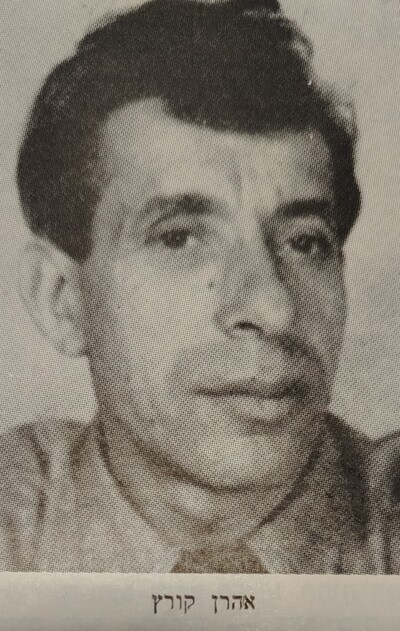
Kurts, Arn-Shmuel
July 28, 1891–May 30, 1964
He was a poet, born in Osve (Asvyeya?), Vitebsk Province, Byelorussia. He received a traditional education. At age thirteen, he took up wandering through the large Russian cities outside the Pale of Settlement, working as a hairdresser. In 1909 he returned to his father’s home in the village of Old Slabode (Slabada), and in 1911 he made his way to the United States. He lived in Philadelphia, New York, and Long Beach (New York).
He debuted in print with poetry in Di Idishe Velt (The Jewish World) in Philadelphia (1916), also using the pen name Azrael. He published in: Z. Vaynper’s Baym Fayer (By the Fire) (Philadelphia, 1920); In Zikh (Introspective) (1923); 1925; 1926; Unzer Bukh (Our Book) (New York, 1927-1928); Nay Lebn (New Life) (New York, 1936 and later); and in his own publications Der Tsvayg (The Branch) (Philadelphia, 1919—four issues), Kurts’s Notitsn (Kurts’s Notices) (Philadelphia, 1922—two issues), and Haytike Lider (Poetry Today) (New York, 1957-1964) which was a quarterly serial of poetry which he filled out himself with poetry, essays, and translations.
Kurts rejected both the psychological realism of the Introspectivists and the striving after intelligibility and conventional forms of Soviet Yiddish poetry.
After 1926 when he became a member of the Communist Party, he wrote only in leftist organs: Der Hamer (The Hammer), Signal (Signal), Morgn-Frayhayt (Morning Freedom), Der Funk (The Spark), Der Kamf (The Struggle) in Toronto, Zamlungen (Collections), Yidishe Kultur (Jewish Culture), and Sovetish Heymland (Soviet Homeland), among others.

His poetry was represented in: Kurland and Rokhkind, Di Haynttsaytike Proletarishe Yidishe Dikhtung in Amerike (Contemporary Proletarian Yiddish Poetry in America) (Minsk: State Publ., 1932); Nakhmen Mayzil, Amerike in Yidishn Vort (America in the Yiddish Word) (New York, 1955); Y. A. Rontsh, Amerike in deR Yidisher Literatur (America in Yiddish Literature) (New York, 1945); and Charles Dobzynski, Anthologie de la Poésie Yiddish, le Miroir d’un People (Anthology of Yiddish Poetry, the Mirror of a People) (Paris: Gallimard, 1971).
The journal IKOR (Yidishe Kolonizatsye Organizatsye in Rusland [Jewish Colonization Organization in Russia]) (New York, 1932) published his two one-act plays.
Others of his works include:
Khaos (Chaos) (New York, 1920), 160 pp.;
Figaro, Poeme (Figaro, a Poem) (New York, 1924), 64 pp.;
Plakatn (Posters), poetry (New York: Yidish lebn, 1927), 80 pp.;
Di Goldene Shtot, Lider un Poemes (The Golden City, Poetry) (New York: International Labor Order, 1935), 160 pp.;
No-Pasaran, Lider, Balades un Poemes fun Shpanishn Folk in zayn Kamf Kegn Fashizm (No Pasarán [They Shall Not Pass], Poetry and Ballads of the Spanish People in Their Fight Against Fascism) (New York, 1938), 95 pp.;
Moyshe Olgin (Moyshe Olgin), poetry (Cleveland, 1940), 15 pp.;
Mark Shagal (Marc Chagall), a poem (New York: Mayne lider, 1946), 94 pp.,
English edition, Marc Chagall: A Poem (Long Beach, NY, 1961), 92 pp.;
Lider (Poetry) (New York: Book Committee, 1966), 384 pp. This collection does not fully reflect Kurts’s pre-Communist work.
Poetically, Kurts was an epigonic modernist. The main influences on him were Mayakovsky, Mikhl Likht, Yankev Glatshteyn, and A. Glants-Leyeles. He expressed the two opposing poles of his poetic personality most vividly in his figures of Figaro and Shmuel Barbiero. As N. B. Minkov put it: “Figaro is a chaotic fire, Barbiero—quiet, tame, fresh, and a joyous mystery known as the earth.”
He died in Long Beach.
Sources: Zalmen Reyzen, Leksikon, vol. 3; N. B. Minkov, in 1925 (New York) 1 (1925); H. Gold, in Unzer Bukh (New York) 1 (1926), pp. 371-73; Yankev Glatshteyn, in Unzer Bukh 1 (1926), pp. 53-54; D. B. Malkin, in Bikher-Velt (Warsaw) (1928), p. 345; A. Pomerants, in Proletpen (Kiev) (1935), p. 237; L. Khanukov, Literarishe Eseyen (Literary Essays) (New York, 1960), pp. 108-21; B. Grin, in Idishe Kultur (New York) (November 1964); Y. Yeshurin, Arn Kurts-Biblyografye (Bibliography for Arn Kurts) (New York, 1966).